
The Visibility Trap
Context note: This post presents conceptual reflections on research. It does not describe, assess, or report on any specific organization. All examples are synthetic or composite and non-attributable.
I want to start with something that surprised me.
Throughout this research, I noticed a consistent pattern: when the agreement structure within an organization is weak, the members tend to have less agreement on what actually governs their work. At first, I thought this might be a measurement error. However, after reflecting more, I realized it's not a mistake in the data but rather a natural outcome of how weak agreement systems operate. Ritchie-Dunham's (2014) idea of the agreements field, which describes the environment where people interact through conscious or unconscious agreements based on shared assumptions, helped me understand why this pattern is so consistent. In a weak agreements field, these underlying assumptions aren’t just undeveloped; they are truly invisible because invisibility is essential for the field to function smoothly.
This note is my effort to understand what that implies. I am not offering a final argument. I realize that the more I write about agreement infrastructure, the more I find myself immersed in the subject. I will return to this idea later.
Here's what the pattern really shows us: weak agreement systems aren't just failing to bring about clarity, they're actually creating the very conditions that make clarity impossible to emerge.

Image 29-1: The Invisible Structure of Friction
An unnamed structure of high diversity and high interconnectedness creates invisible, anxiety-inducing friction when simple operational handoffs are attempted between diverse departments.
Here's my current understanding of the mechanism. When explicit agreements are lacking or poorly enforced, another factor assumes the role of coordination: relational conformity. In such cases, individuals respond more to social signals than to shared rules. They ask themselves, 'What does the person above me expect?' or 'What do my colleagues accept without issue?' and 'Who bears the friction without acknowledging it?' I should note that labeling this as "relational conformity" is already interpretive. It points to the gap identified by Argyris and Schön (1978) between espoused theory, what people and organizations claim they do, and theory-in-use, which is their actual behavior. In systems with weak agreements, these two often diverge significantly, and this divergence is intentional, not accidental.
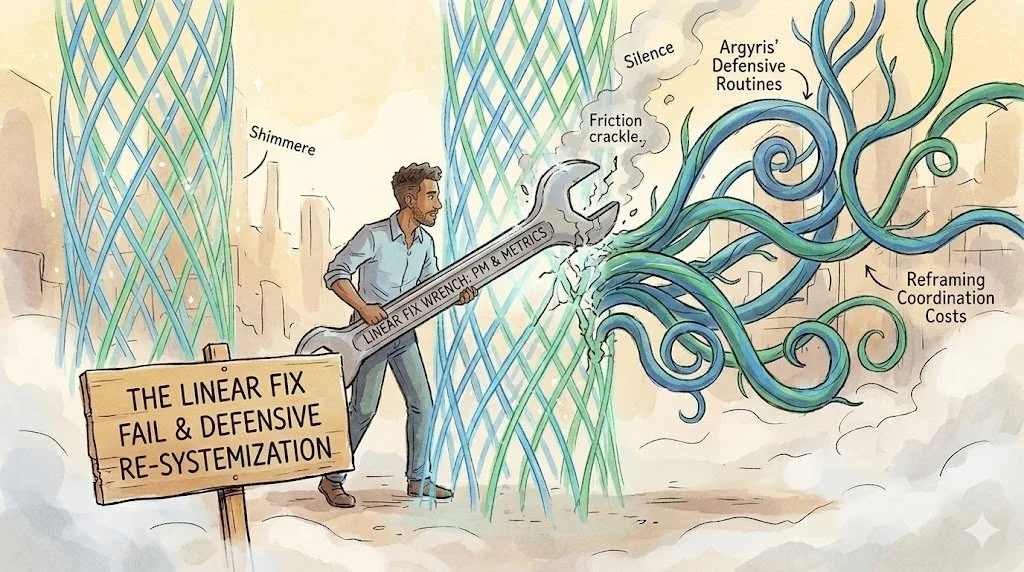
Image 29-2: The Linear Fix Fail
Using traditional, linear tools (metrics and standard PM) to resolve complex, unwritten organizational issues causes the tools to fail, instantly triggering defensive organizational routines that maintain the system’s status quo.
Scott (2014) outlines three main pillars that enable institutions to persist: the regulative (such as rules, laws, and sanctions), the normative (values, norms, obligations), and the cultural-cognitive (shared beliefs and taken-for-granted assumptions). In weak agreement systems, the cultural-cognitive pillar is often dominated by conformity patterns that replace explicit agreements. This drives the visibility trap: conformity operates at the cultural-cognitive level, where it is perceived not as a choice but as the natural way things are. Meyer and Rowan (1977) called this process decoupling, where organizations implement formal structures to gain external legitimacy while keeping their technical activities separate from actual compliance. This decoupling isn’t cynical but a rational institutional response to an environment that values policies on paper more than their actual execution.
Before proceeding, I want to clarify something because there's a potential misunderstanding I need to address. Making implicit agreements explicit isn't inherently good. Highly explicit agreement systems can be effective at extraction, just like flourishing. For example, a social system might have very explicit rules that coordinate behavior efficiently. Still, it has neither feedback loops nor processes to transform itself embedded, thus unable to create the conditions necessary for flourishing, as described by Ritchie-Dunham (2014). What's important isn't just whether agreements are visible but also at which level they are present (noun, noun+verb, or noun+verb+possibility), what they aim for, and whom they benefit. Ritchie-Dunham distinguishes between agreement fields focused on scarcity, where value is extracted from some for others’ benefit, and those focused on abundance, which promote shared value creation. The visibility trap I mention is specific: it occurs in systems where coordination costs are quietly absorbed by those least able to refuse, and revealing this absorption would threaten the extraction that depends on it. Visibility is necessary for renegotiation, but doesn't guarantee regenerative outcomes.
This leads to a hypothesis I have been sitting with for some time, though I have not fully resolved it. In extractive agreement systems, implicitness isn't accidental; it's purposeful. Keeping coordination terms ambiguous allows room for renegotiation, which extraction relies on. Conversely, explicit agreements, such as clear role boundaries, documented accountability, and defined mandates, limit this flexibility by formalizing responsibilities and restricting informal cost reallocation. Those in positions of authority who gain from this informal reshuffling have structural incentives to keep these terms vague, whether they realize it or not.
This last distinction is less significant than it might initially seem. Kegan (1994) suggests that at the Socialized Mind, or Order 3 in his model, individuals tend to create conformity and protective behaviors not mainly through strategic thinking, but because the social environment is built around these patterns. The self reflects social expectations. What may appear to an outsider as strategic ambiguity can, from an internal perspective, simply be the natural state of things. Whether this implicitness is consciously maintained or structurally ingrained through socialization processes, it does not alter the outcome of coordination; those who cannot handle the ambiguity bear its cost.
What I find genuinely challenging to accept here, and I want to acknowledge it rather than smooth it over, is that this framework makes individual actors appear fully rational in their own perspective and completely responsible for outcomes they may not even perceive. Rooke and Torbert (2005) provide empirical evidence that actors functioning from higher action logics display significantly different abilities to surface implicit coordination agreements. Cook-Greuter (2013) frames this as part of a developmental path: at conventional ego stages, the self is defined by social belonging and role performance in ways that conceal its coordinating role. Moving into postconventional stages involves developing the capacity to reflect on one's social embeddedness. Therefore, the question of what someone can be held responsible for is inherently tied to the developmental ability to see and understand that responsibility.
When someone within an extractive system starts to clarify implicit agreements, the system reacts with a familiar set of defenses. Argyris (1990) called these organizational defensive routines: behaviors that shield individuals and organizations from threats or embarrassment, while also blocking the learning process that would challenge the underlying assumptions causing the threat. Such routines include appeals to social norms, legitimacy frames that obscure accountability, urgency that reduces deliberation time, and reframings that shift the focus of coordination costs from the structure to individual actions. Each tactic aims to protect the implicit agreement by making explicit renegotiation seem costly, disloyal, or unnecessary. These routines are generally not malicious; rather, they are self-protective and, from the cultural-cognitive frame of the extractive system, entirely rational.
DiMaggio and Powell (1983) described normative isomorphism as a key process that makes organizational practices seem natural. This happens through the professionalization of roles and the normalization of informal expectations, turning what is essentially a contingent and extractive setup into the perceived natural order. The individual who points out the unspoken rule does not see themselves as a reformer but as a troublemaker. Within the system's logic, they are indeed disrupting the core element, its currency, that sustains coordination.
A second, more complex structural feature builds on the first, and understanding it took me longer. This includes roles that carry accountability without explicit authority, tasks that are informally transferred to whoever does not resist, and resource gaps that remain hidden as long as someone quietly compensates. These are not mere management failures but deliberate coordination strategies that benefit the institution by avoiding formalization of its extractive practices. PhD Note 12: When a System Says We Can't Move Without Maya offers a different perspective: the person who bears this structural burden becomes essential precisely because the structure itself is unnamed. The burden isn't just borne but systematically allocated, silently and systematically, to those least (able to) push back. This allocation itself is a form of implicit agreement, only visible when someone refuses to continue to act on it.
This addition to the discussion in PhD Note 28: Agreements Without Control introduces a mechanism that the earlier analysis did not cover. Note 28 pointed out that visibility is necessary for change, but does not directly modify the agreement layer. I now realize more precisely that visibility is not neutral in systems where invisibility facilitates coordination, especially when that coordination is extractive. Making agreements explicit shifts who bears the cost of coordination. It also shifts the extraction, as seen from inside the system, from natural to chosen. And that shift is resisted at both structural and developmental levels because it threatens both the coordination system and the self-understanding of those immersed in it. It shifts who is being extracted and what is taken, leading people to defend their position.
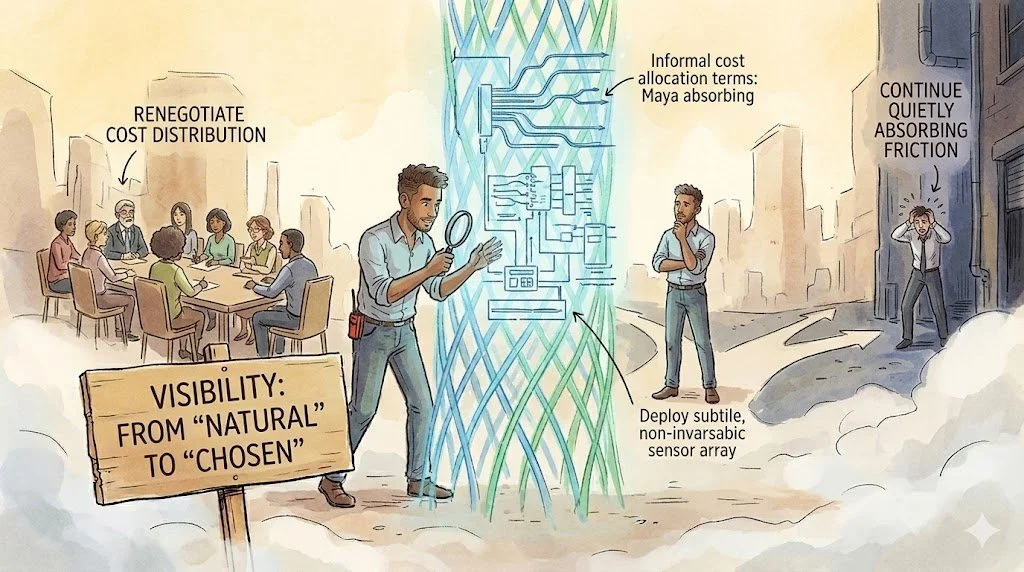
Image 29-3: Visibility: Natural vs. Chosen
Making unwritten agreements visible creates profound disruption, turning a perceived 'natural order' into a conscious organizational choice. This forces a high-stakes decision: renegotiate the cost distribution or continue quietly exploiting those who absorb the friction.
As I write this, I realize the post is exemplifying what it describes. By identifying this pattern, I turn what was once implicit into something explicit. Whether this is seen as disruptive or clarifying depends on your perspective within the coordination system and your developmental awareness.
An open question remains: under what conditions can someone explore the underlying agreement layer without shouldering all the costs alone? I observe that in some coordination situations, this excavation has already occurred, not by internal members but by external actors who have formalized certain agreement terms into publicly accessible frameworks. Consequently, the cost of explicitly stating specific agreements is borne not by those willing to do so, but is redistributed in advance to a higher organizational level. The next issue to address is why systems tend to develop informal coordination patterns that conflict with these pre-established frameworks, and how such contradictions can exist within an extractive system.
References
Argyris, C. (1990). Overcoming organizational defenses: Facilitating organizational learning. Allyn and Bacon.
Argyris, C., & Schön, D. A. (1978). Organizational learning: A theory of action perspective. Addison-Wesley.
Cook-Greuter, S. R. (2005). Ego Development: Nine levels of increasing embrace [Prepublication manuscript]. https://integralartlab.com/wp-content/uploads/2020/12/9-levels-of-increasing-embrace-update-1-07.pdf
DiMaggio, P. J., & Powell, W. W. (1983). The iron cage revisited: Institutional isomorphism and collective rationality in organizational fields. American Sociological Review, 48(2), 147–160. https://doi.org/10.2307/2095101
Kegan, R. (1994). In over our heads: The mental demands of modern life. Harvard University Press.
Meyer, J. W., & Rowan, B. (1977). Institutionalized organizations: Formal structure as myth and ceremony. American Journal of Sociology, 83(2), 340–363. https://doi.org/10.1086/226550
Ritchie-Dunham, J. L. (2014). Ecosynomics: The science of abundance. Vibrancy Publishing.
Ritchie-Dunham, J. L. (2016). Agreements field mapping. Reflections of a Pactoecographer. https://jimritchiedunham.wordpress.com/2016/07/25/agreements-field-mapping/
Rooke, D., & Torbert, W. R. (2005). Seven transformations of leadership. Harvard Business Review, 83(4), 66–76. https://hbr.org/2005/04/seven-transformations-of-leadership
Scott, W. R. (2014). Institutions and organizations: Ideas, interests, and identities (4th ed.). Sage.