
Agreements Without Control
Context note: This PhD Note presents conceptual research reflections. It does not describe, assess, or report on any specific organization. All examples are synthetic or composite and non-attributable. It is based on my ongoing field work.
In my previous PhD note, I argued that making ecosystem structure visible is an architectural achievement, not a cognitive one, and that visibility is a precondition for a different kind of agreement. This post examines what that different kind of agreement requires and why it cannot be constructed from outside the ecosystem.
The formalization trap
I observe a recurring response to the discovery that an ecosystem has more structure than initially believed: stakeholders have the urge to formalize and manage it. Name the dependencies. Sign the agreements. Install the governance. This response is not wrong, but it is incomplete in a specific way. Formalization works when the categories available for agreement correspond to the actual value flows and dependencies in the field. When they do not, formalization does not stabilize coordination. It displaces or disrupts it. Imagine a lion wanting to control the savanna. It sounds impossible, doesn’t it?
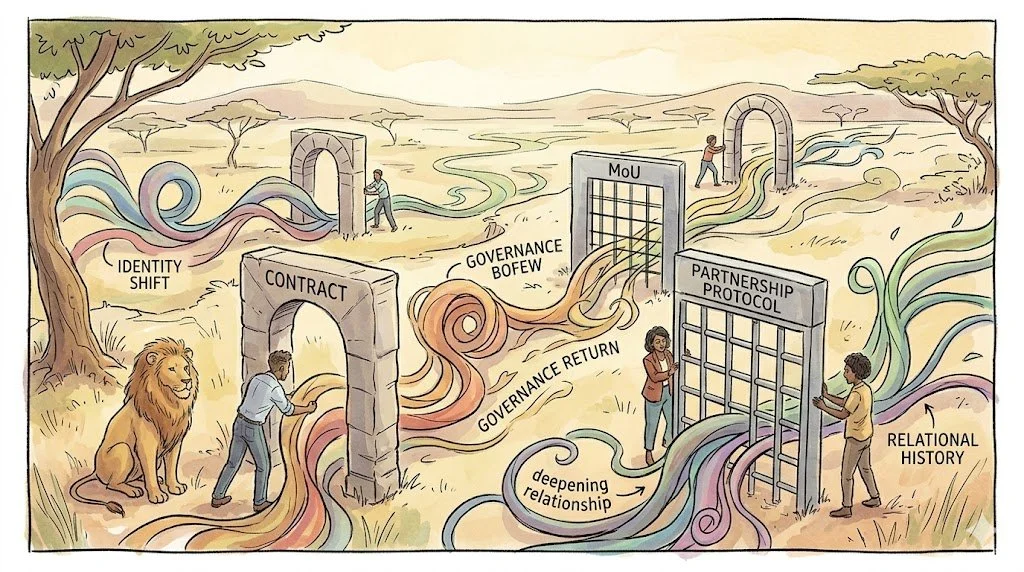
Image 28-1: Attempting to fit organic ecosystem dynamics like 'identity shifts' and 'governance returns' into rigid geometric agreement templates (Contracts, MoUs) designed for generic organizational constraints. The generic frames only make these complex flows invisible again.
Generic agreement frameworks (contracts, memoranda of understanding, partnership protocols) are calibrated to generic organizational interactions. They distribute roles, resources, and responsibilities according to categories that assume a relatively stable, bounded, and symmetric relationship between actors. They are not designed to name the kind of value that moves in ecosystems: the governance return that one actor extracts from a relationship without the other naming it, the identity shift in an institution that changes its decisions years later, the compounding quality of a relationship that deepens rather than routinizes. When generic frameworks are applied to these dynamics, they do not make them governable. They make them invisible again, this time beneath a layer of formal language that no longer corresponds to what is actually happening.
Why vocabulary has to come from the field
A vocabulary adequate to ecosystem agreements must be built from the causal structure of that specific ecosystem. This is not a preference for local knowledge over general theory. It is a structural requirement. The reason is this: the value flows, and dependencies that need to be named are specific to the relational history of the actors involved. They are not generic. A regional (creative) ecosystem generates different forms of institutional value than a supply chain network or a professional association. The coordination mechanisms that have stabilized it, often without explicit design, reflect the particular sequence of episodes through which trust was established, expectations were calibrated, and informal governance developed.
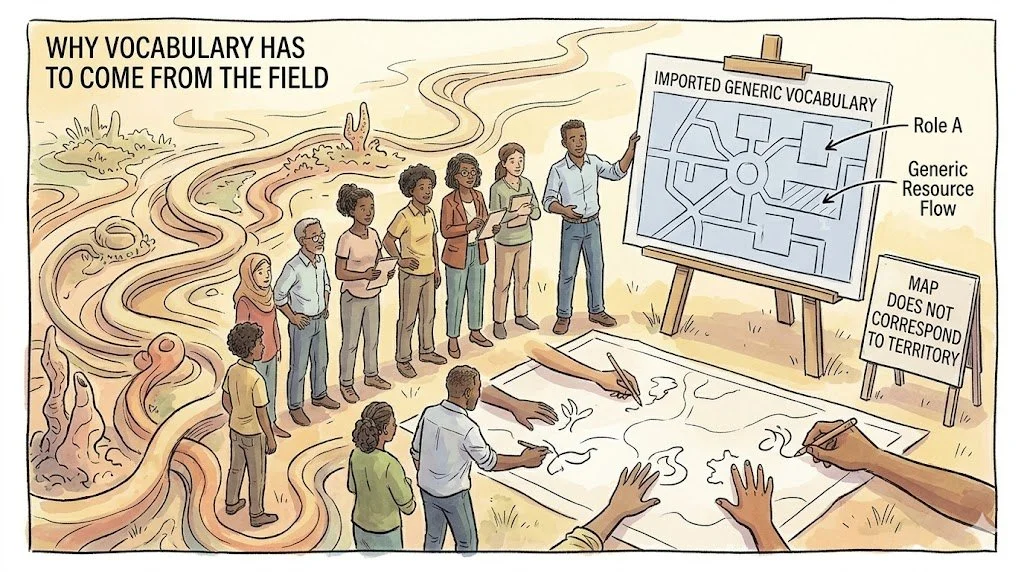
Image 28-2: The Map-Territory Gap: Actors coordinate against an imported blueprint (map) that does not correspond to the actual causal structure and relational territory of their specific business ecosystem. Effective vocabulary must be built from the field up, derived from demonstrated interactions.
A vocabulary imported from outside the ecosystem cannot name these dynamics precisely because it was not built to see them. It can approximate. It can impose categories that are close enough for some purposes. But approximation at the level of agreement is not a minor limitation. Agreements govern coordination, outcomes, identity, and investments. When the vocabulary of agreements does not match the field’s actual dependency structure, actors coordinate against a map that does not correspond to their territory. The ecosystem model described in the previous PhD Note changes this condition. Once the causal structure of an ecosystem is made visible through its coordination episodes, actors have a shared object around which vocabulary can be built. The model does not supply the vocabulary. But it creates the conditions under which a vocabulary adequate to the specific field can be developed and tested.
Coordination without control
This points to a deeper structural feature of ecosystem coordination that generic and linear frameworks tend to obscure. In organizational settings where control is available, agreements can be enforced. Deviation is costly. Compliance is monitorable. The agreement functions as a mechanism of constraint. In ecosystem settings, control is structurally unavailable. Actors are independent. Their participation is conditional on sufficient alignment of interests and values, not on a formal obligation. The agreement layer cannot function as a mechanism of constraint without risking the withdrawal of the actors it is trying to bind.
What this means is that an agreement adequate for ecosystem coordination has to perform a function other than that of constraint. It has to stabilize expectations without eliminating the flexibility that independent actors require to remain in the field. It has to name dependencies without converting them into obligations that exceed what the relationship can carry. This is a design problem that has not been well theorized. Most organizational impact frameworks were developed for settings in which control is available. The coordination logic they encode does not transfer to settings where it is not.
What becomes visible to me in my work across ecosystems where coordination has been sustained over time, without control, is that the agreements in operation tend to share a structural feature: they are grounded in relational history and shared deeper purpose rather than formal authority. They name what actors have already demonstrated they can do together. They incrementally extend the scope of what has already been shown to hold. This observation confirms Ritchie-Dunham's research on agreement systems (Ritchie-Dunham, 2016). My main insight is that this is not informality. It is a different architecture of commitment, one that derives its stability from demonstrated capacity rather than from imposed obligation.
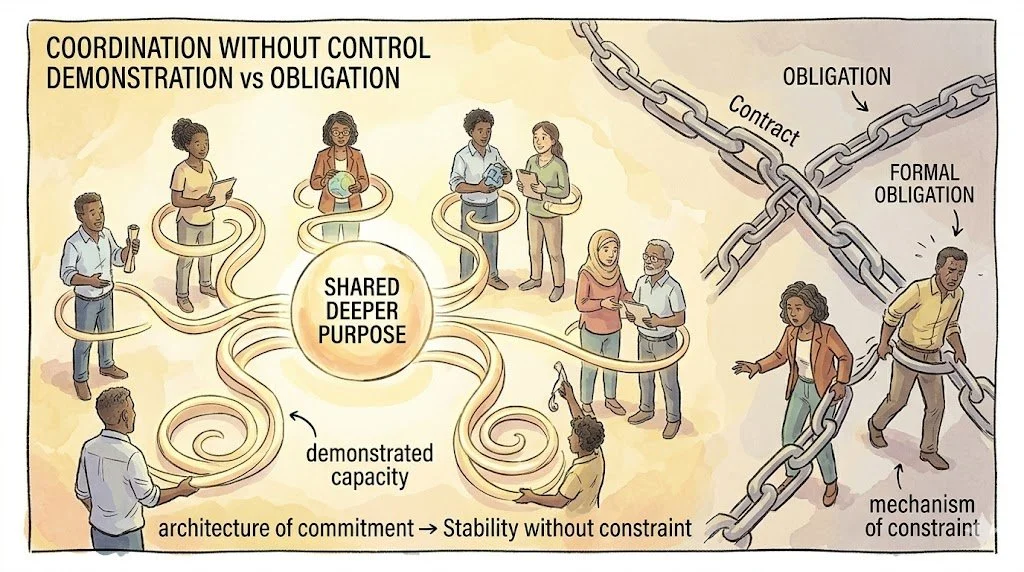
Image 28-3: Two distinct architectures of commitment: Imposed obligations (heavy geometric chains) fail when control is unavailable. Sustainable ecosystem coordination is derived from organic connections that emerge from demonstrated capacity and shared deeper purpose, providing stability without constraint.
What remains open
Making this architecture explicit, so that it can be recognized, replicated, and extended, is a different challenge than making the ecosystem structure visible. Visibility, as the previous PhD Note argued, is an architectural achievement. But the agreement layer that could carry what visibility makes possible requires something further: a shared vocabulary precise enough to name actual dependencies, and a coordination logic adequate to settings where control is not available.
Whether such a vocabulary can be designed in advance or only emerge through the sustained practice of building agreements that hold is a question the existing literature on ecosystem governance has not resolved. That question is what this research is attempting to address.
References:
Ritchie-Dunham, J. (2016, July 11). A common object-ive is not a deeper shared purpose: How to know the difference. Reflections of a Pactoecographer. https://jimritchiedunham.wordpress.com/2016/07/11/a-common-object-ive-is-not-a-deeper-shared-purpose-how-to-know-the-difference/