
The Translation Gap
Context note: This post presents conceptual reflections on research. It does not describe, assess, or report on any specific organization. All examples are synthetic or composite and non-attributable.
In my research on agreement infrastructure, I was surprised to discover how much conceptual groundwork has already been laid. This work wasn’t done by me or within individual organizations but by overarching frameworks such as legal instruments, international standards, collective agreements, and governance codes. As I examined the gap between organizations' formal commitments and their actual practices, I consistently found an unsettling pattern: the coordination challenges I was exploring had often been previously addressed. The solutions were available publicly, legally binding, yet frequently overlooked.
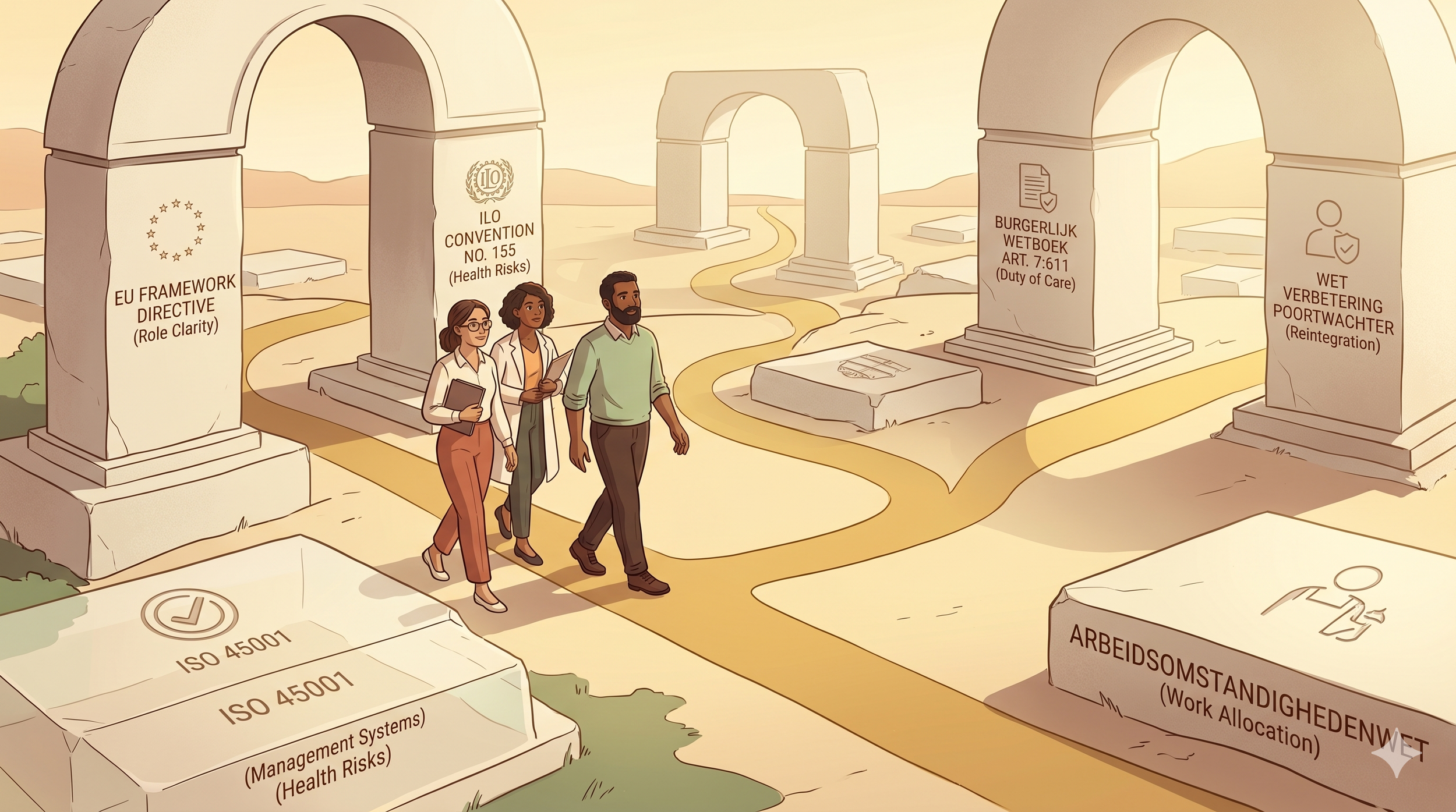
You don't have to build healthy coordination from scratch; a vast foundation of laws and standards is already pre-excavated for you.
Scott (2014) identifies three pillars that uphold institutions: the regulative, the normative, and the cultural-cognitive. The frameworks I refer to as pre-excavated are primarily regulative, being formally codified, legally binding, and intended to set rules for coordination that prevent exploitative practices. For example, the EU Framework Directive on Safety and Health at Work (Council of the European Union, 1989) outlines employer responsibilities concerning role clarity and protection from excessive demands. ILO Convention No. 155 (International Labor Organization, 1981) specifies conditions under which health risks cannot be transferred to individual workers. The EU Working Time Directive (European Parliament & Council of the European Union, 2003) defines how work hours can be organized and renegotiated. ISO 45001 (International Organization for Standardization, 2018) offers an internationally recognized management system for occupational health and safety. Collective labor agreements adapt these principles to sector-specific contexts. In Dutch law, Article 7:611 of the Civil Code (Overheid.nl, 1992) enshrines the employer's duty of care as a coordination obligation. The Wet verbetering poortwachter (Overheid.nl, 2002) mandates reintegration as a formal, explicit process. The Arbeidsomstandighedenwet (Overheid.nl, 2007) details the structural conditions under which work can be allocated without generating health risks.
I want to pause before moving forward. These frameworks are not neutral tools. Berger and Luckmann (1966) demonstrated that what appears to be objective social reality is always a sedimented human construction. These tools result from political processes, contested negotiations, and hard-won compromises about who bears which costs. When I describe them as pre-excavated, I mean they involve labor that others have done, so we wouldn't have to start from scratch. They are not natural laws but accumulated meaning-making about coordination, aligned with Ritchie-Dunham's (2014) perspective, toward the abundance end of the spectrum, focusing on shared value creation, mutual protection, and regenerative organizational logic.
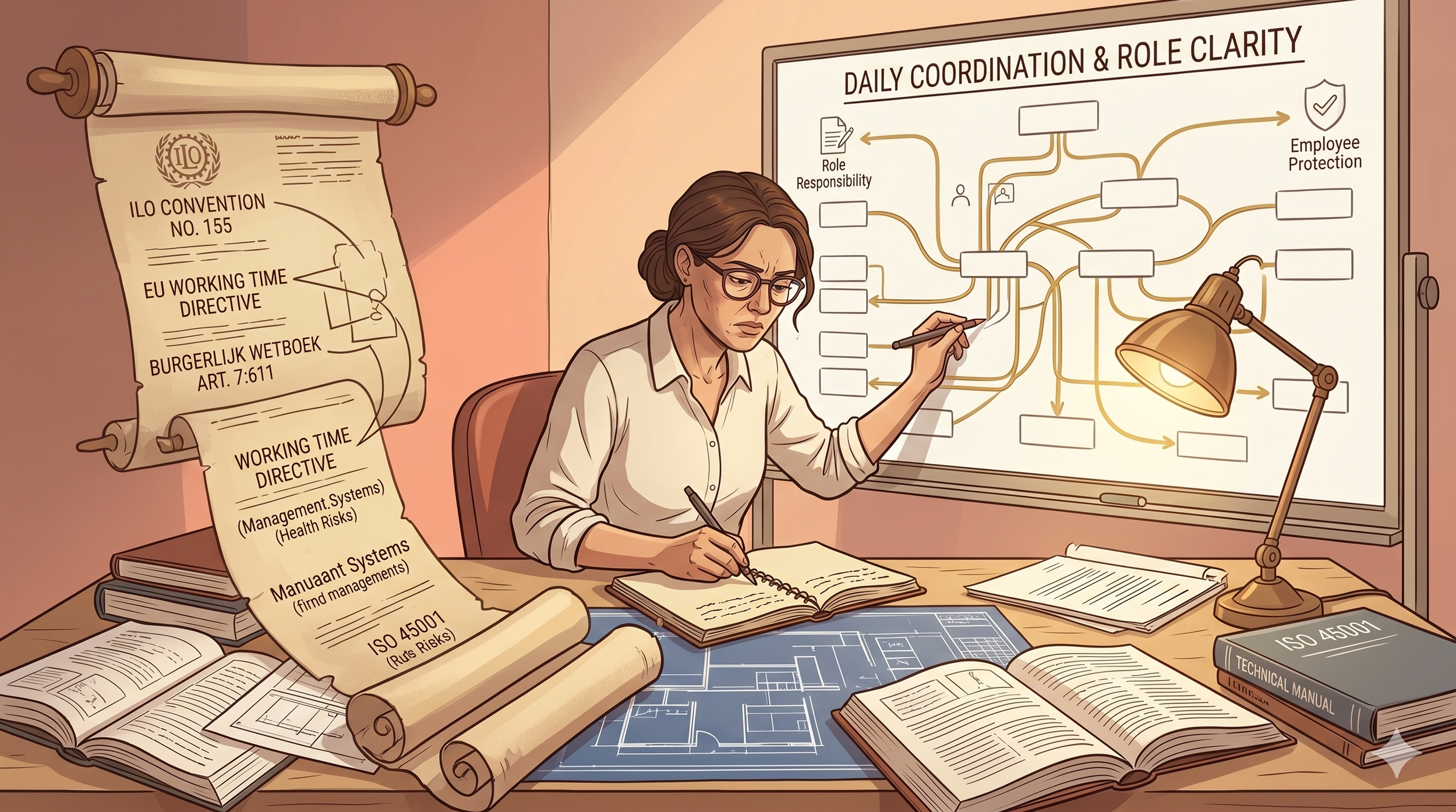
Making abstract laws practical for daily work is an immense, solitary task. This visualizes the individual burden of translating formal external frameworks into real, unwritten team agreements.
This paradox arises because the regulative layer was intended for a more regenerative form of coordination. Yet, the cultural-cognitive layer, as detailed in PhD Note 29, continues to operate in an extractive manner. While the frameworks state one thing, the enacted agreement system acts differently. The decoupling mechanism and the extraction-implicitness hypothesis from PhD Note 29 clarify this: formalizing the pre-established frameworks at the operational level would eliminate the renegotiation space that extraction relies on. Consequently, these frameworks are accessible to everyone and are used selectively.
This note clarifies where the gap ends. When someone inside an extractive system uses these frameworks to regain coordination, they offer authority and sharply lower the cost of excavation. However, they don't implement themselves. The task of applying regulative frameworks at the cultural-cognitive level, where real coordination occurs, still lies ahead. Usually, this work is carried out by the person experiencing coordination issues, not the institution that would benefit most. Overall, any document, operational plan, framework, or conversation prep is created by the employee. The collective labor agreement and occupational health legislation provide the foundation. The translation is entrusted to whoever must do it because they cannot avoid it. These documents serve as agreement footprints, observable evidence that someone did the translation work, and that someone was not the institution.
This asymmetry has a developmental aspect, as explained in full in PhD Note 29: translation demands at least the Self-Authoring capacity associated with Order 4, as defined by Kegan (1994). This capacity enables one to view formal frameworks as tools for coordination rather than as external constraints. Kegan and Lahey (2009) further introduce the idea of immunity to change: organizations may genuinely aim to bridge the gap between their stated frameworks and actual practices, yet remain structurally fixed by competing commitments operating below conscious awareness. This immunity isn't due to bad faith but reflects how meaning is constructed at the developmental level and the organizational system's existing logic.
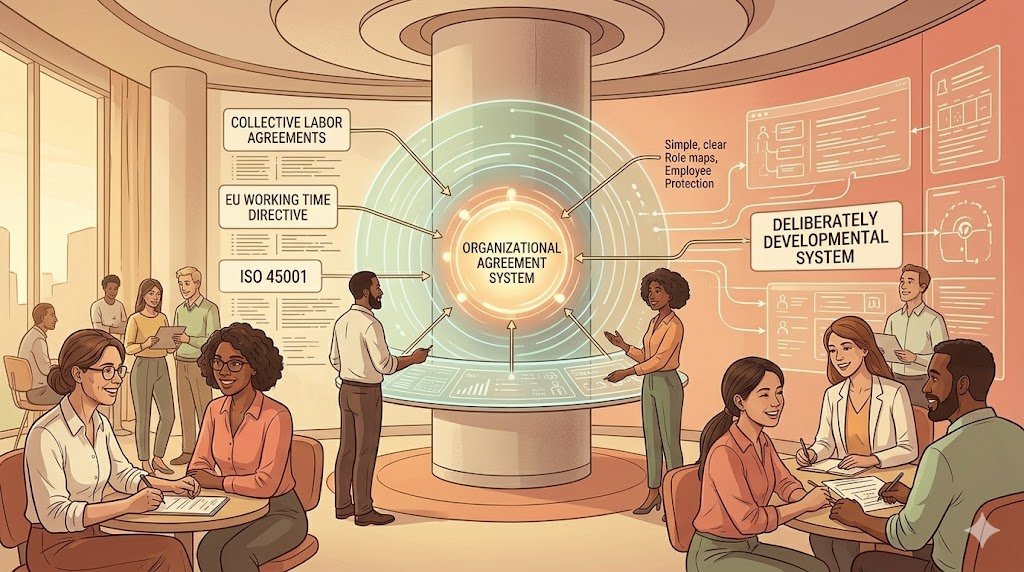
Systemic coordination happens when an organization is designed to apply foundational rules. This visualizes how a deliberately developmental organization lifts the individual burden by integrating existing laws into a shared practice.
As I write this, I realize the post functions as a translation act: transforming frameworks from legal and developmental language into agreement infrastructure terminology. Its usefulness hinges on whether it effectively reaches those who require this language to carry out their own analysis. I cannot determine this from within the writing itself.
Next, I want to address the question of organizational conditions. What is needed for an institution to develop translation capacity systematically, rather than relying on individuals to do that work alone? This question aligns with Kegan and Lahey's (2009) concept of the deliberately developmental organization and Ritchie-Dunham's (2014) idea of the conditions necessary for ongoing abundance-focused coordination. It also links the research on agreement infrastructure directly to organizational design.
References
Berger, P. L., & Luckmann, T. (1966). The social construction of reality: A treatise in the sociology of knowledge. Anchor Books.
Cook-Greuter, S. R. (2013). Nine levels of increasing embrace in ego development: A full-spectrum theory of vertical growth and meaning making [Prepublication manuscript]. https://integralartlab.com/wp-content/uploads/2020/12/9-levels-of-increasing-embrace-update-1-07.pdf
Council of the European Union. (1989). Council Directive 89/391/EEC on the introduction of measures to encourage improvements in the safety and health of workers at work. Official Journal of the European Communities. https://eur-lex.europa.eu/legal-content/EN/TXT/?uri=CELEX:31989L0391
DiMaggio, P. J., & Powell, W. W. (1983). The iron cage revisited: Institutional isomorphism and collective rationality in organizational fields. American Sociological Review, 48(2), 147–160. https://doi.org/10.2307/2095101
European Parliament & Council of the European Union. (2003). Directive 2003/88/EC concerning certain aspects of the organisation of working time. Official Journal of the European Union. https://eur-lex.europa.eu/legal-content/EN/TXT/?uri=CELEX:32003L0088
International Labour Organization. (1981). C155 — Occupational Safety and Health Convention (No. 155). ILO NORMLEX. https://www.ilo.org/dyn/normlex/en/f?p=NORMLEXPUB:12100:0::NO::P12100_ILO_CODE:C155
International Organization for Standardization. (2018). ISO 45001:2018: Occupational health and safety management systems — Requirements with guidance for use. ISO. https://www.iso.org/standard/63787.html
Kegan, R. (1994). In over our heads: The mental demands of modern life. Harvard University Press.
Kegan, R., & Lahey, L. L. (2009). Immunity to change: How to overcome it and unlock the potential in yourself and your organization. Harvard Business Press.
Meyer, J. W., & Rowan, B. (1977). Institutionalized organizations: Formal structure as myth and ceremony. American Journal of Sociology, 83(2), 340–363. https://doi.org/10.1086/226550
Overheid.nl. (1992). Burgerlijk Wetboek Boek 7, Artikel 611: Goed werkgeverschap en goed werknemerschap. https://wetten.overheid.nl/BWBR0005290
Overheid.nl. (2002). Wet verbetering poortwachter. https://wetten.overheid.nl/BWBR0013063
Overheid.nl. (2007). Arbeidsomstandighedenwet. https://wetten.overheid.nl/BWBR0010346
Ritchie-Dunham, J. L. (2014). Ecosynomics: The science of abundance. Vibrancy Publishing.
Ritchie-Dunham, J. L. (2016). Agreements field mapping. Reflections of a Pactoecographer. https://jimritchiedunham.wordpress.com/2016/07/25/agreements-field-mapping/
Rooke, D., & Torbert, W. R. (2005). Seven transformations of leadership. Harvard Business Review, 83(4), 66–76. https://hbr.org/2005/04/seven-transformations-of-leadership
Scott, W. R. (2014). Institutions and organizations: Ideas, interests, and identities (4th ed.). Sage.