
Giving Back Without Consulting: Why I Refuse Recommendations
Applied research has a built-in tension: you are expected to be beneficial to society, but the moment you start behaving like a solutions vendor, you risk turning inquiry into implementation support and truth-seeking into client-pleasing. That tension is not a side issue. It is the core design problem of engaged scholarship.
In his award-winning book, Andrew Hoffman frames this as a challenge of relevance and responsibility: scholarship operates under a social contract and is expected to generate value beyond academia, especially in a time when trust, legitimacy, and public impact are contested (Hoffman, 2021). I read that as both a mandate and a warning: give back, but don’t collapse into cheap consultancy. The way out is not to refuse engagement. It is to engage with a different product.
The moment the trap appears
The trap usually shows up as a polite request: “Ok, so what should we do?” In a consulting frame, that question is the gateway to a proposal. In an applied PhD frame, it is a fork in the road. If I answer it with recommendations, I implicitly claim more certainty than I have, invite compliance over learning, and position myself as the authority who “knows the system.” That breaks the kind of inquiry I’m trying to do. So I don’t answer with advice. I offer something different.
What I give back instead of recommendations
I won’t tell you what to do. I will engage you in a co-creative dialogue that gives you access to my ability to integrate and synthesize with you. So you leave with a more precise explanation of what governs outcomes and with the next better question. I treat this as engaged scholarship by design: CAESI (Case-Informed, Action-Engaged Systems Inquiry) lets me give back through evidence-backed working explanations and testable experiments, without collapsing inquiry into consultancy.
That may sound abstract, so here is what it looks like in deliverable form. I give back:
An evidence-backed working explanation (not a diagnosis-as-truth).
Assumptions stated explicitly (so the organization can see what it has been living with).
A conservative translation into performance language (cost, risk, opportunity), without false precision.
A next-step experiment (a small test, not a program).
This is still “giving back,” but the gift is not a solution. The gift is increased legibility and agency: the ability to see the system’s coordination logic and to test what changes it.
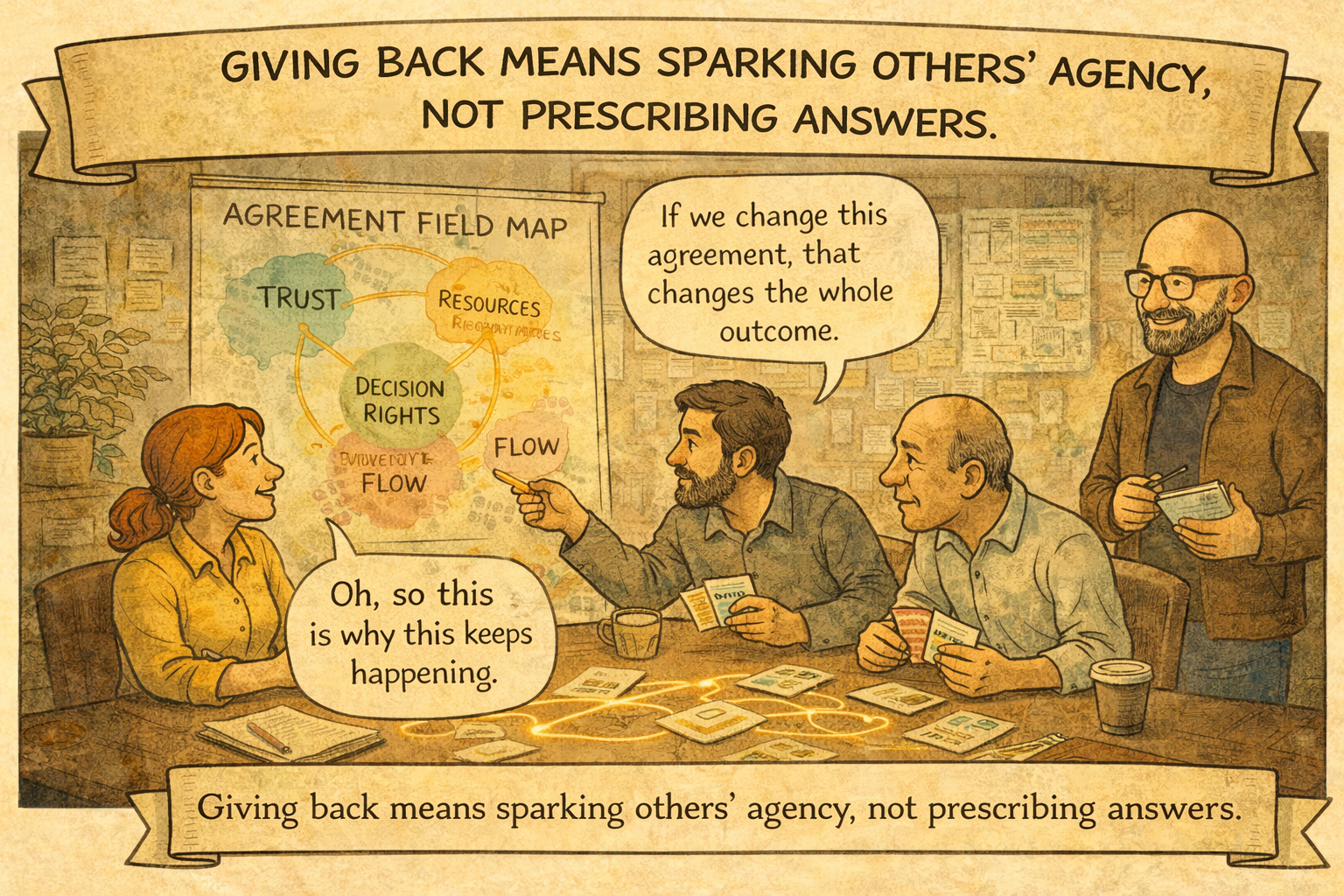
Why does this fit engaged scholarship better than advice?
Hoffman's argument is not “be useful at any cost.” It’s that scholars should expand their impact while staying faithful to rigor, clarity about claims, and the distinction between evidence and opinion (Hoffman, 2021). Recommendations often blur that boundary by smuggling in certainty. They turn a partial inference into a prescribed path, making it hard to tell where evidence ends and preference begins.
An experiment proposal does something different. It treats the organization as the rightful owner of action and the researcher’s role as improving the quality of seeing and testing. It also respects a basic reality of complex systems: you don’t implement your way into a better future; you prototype your way into it, one testable shift at a time.
The ethical line I’m protecting
This refusal is not about moral purity. It is about protecting methods. If I become the person who tells you what to do, I make you dependent on my certainty. If I help you see what governs outcomes and design a test, I make you capable of learning without me. That is the form of giving back I can defend as applied research: it creates local capacity, it stays honest about uncertainty, and it prevents the slide from engaged scholarship into performative expertise. And it is also the cleanest way I know to keep a PhD project grounded in service without turning it into consulting disguised as research.
References
Hoffman, A. J. (2021). The engaged scholar: Expanding the impact of academic research in today’s world. Stanford University Press. URL: https://www.sup.org/books/business/engaged-scholar
Note: This text reflects conceptual research thinking. It does not describe or assess any specific organization. Examples and situations referenced are synthetic or composite and are used solely for analytical purposes.