
De-Personing Legitimacy: A Two-Week Micro-Experiment Cycle with the Agreement Cards
Context note
This post presents conceptual research reflections. It does not describe, assess, or report on any specific organization. All examples are synthetic or composite and non-attributable.
In the previous Maya vignette (“When a System Says We Can’t Move Without Maya”), the signal was a person-bound legitimacy: progress waited for someone with influence but no mandate. This follow-up keeps Maya as a composite protagonist but tracks the next signal that often appears the moment a bridge role tries to “do it properly”: when Maya attempts to make ownership explicit, the system answers with process. Not as malice, but as coordination physics.
Maya is not the formal owner. She is a bridge role, used because she can translate across domains, protect external credibility, and reduce friction. That is precisely why dependency becomes structurally dangerous: a bridge quietly becomes a load-bearing wall. The diagnostic move in this episode is simple. Maya stops carrying “between layers” and asks a clean question: where do legitimacy and ownership sit for decisions that matter externally? A standard reply sounds neutral yet functions as an agreement claim: “This needs to go through the line / HR / the formal route.” That sentence is not “bureaucracy”; it is a claim about where decisions become real. The Agreement Card Deck is useful here because it prevents the collapse into advice: it forces the same discipline each time, makes the coordination claim explicit, anchors it in footprints, surfaces cost/risk logic under uncertainty, and defines a bounded micro-experiment with a stop/revert rule that can generate new evidence.
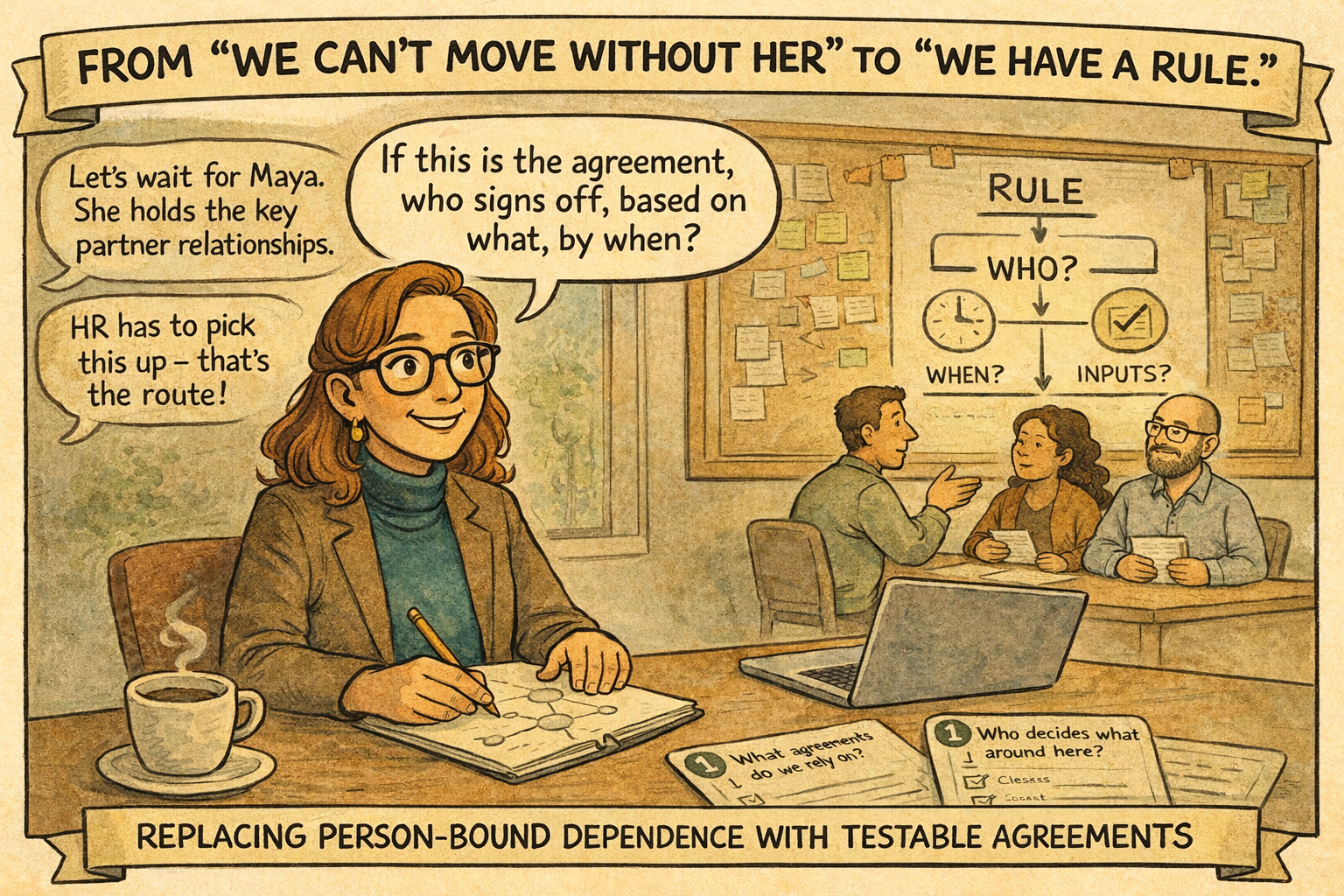
Card #1 — Decision rights & legitimacy.
Prompt: Who decides, and what makes a decision legitimate across the field? The coordination claim hidden in “it must go through the route” is that a decision is not real unless it is routed through the recognized chain.
Typical footprints are linguistic and repetitive: “administratively it doesn't work that way,” “we can’t decide on one person’s experience,” “first get wide support.”
The cost/risk logic is not abstract: when legitimacy is granted only through a route no one actively hosts, the system can look orderly while remaining static. Under external dependency, latency becomes reputational risk.
A minimal experiment is therefore not a “program” but a temporary legitimacy rule for one recurring decision type: what counts as done, whose sign-off makes it final, and what minimum inputs are required.
The test is observable: do reopens, bypasses, and “we need X first” loops decrease, or are they simply relocated?
Card #2 — Reliance agreements.
Prompt: What agreements do we rely on without naming them?
The pattern tends to show up as a double reliance: if it matters externally, the system relies on a bridge person; if the bridge person asks for a mandate, the system relies on process. Both moves can be sincere; both can still dissolve ownership.
Footprints often read like principled governance while functioning as load shifting: “HR must pick this up,” “director/lector must carry it,” “we support it, but…”.
The cost/risk logic is that the system buys psychological safety (no one takes the political hit) while coordination exposure remains concentrated and reversible.
A bounded experiment is to make escalation thresholds explicit for one interface where reliance flips (person → process): what must be true before routing upward is justified, and what counts as a resolved handoff. Again, the output is evidence, not persuasion.
Card #13 — Functional boundaries and handoffs.
Prompt: Who controls what, and where are the handoff points?
This card explains why “just hand it to the line” frequently fails: handoffs fail less because people are unwilling than because the boundary is not designed.
Footprints show up as grey zones that no team recognizes as its remit, repeated “not our job” responses, and deliverables that are “almost done” but unusable because key assumptions were never transferred.
The cost/risk logic is articulation work: invisible patching done by the bridge role to keep the system functional. When the bridge stops patching, the system experiences “sudden” failure, even though the traces were present.
A minimal boundary stub is often enough to test the mechanism: one page naming sponsor, operational owner, and the single handoff artifact that must exist for the next step to be legitimate. If movement still routes back to personalities, the footprint claim becomes sharper rather than more emotional.
Prompt: What do we avoid talking about even though it shapes outcomes?
In these episodes, the avoided topic is rarely “conflict”; it is power in plain language: mandate, ownership, legitimacy, and what counts as authorized action.
Footprints include polite deflection, jokes when the mandate is mentioned, “we don’t need to formalize it,” paired with “we can’t proceed.”
The cost/risk logic is straightforward: avoided mandate conversations do not remove politics; they privatize politics into the coordination layer, where it returns as dependency, delay, and quiet status games.
A minimal experiment is a timeboxed conversation with one strict rule: no personality stories, only competing assumptions about legitimacy and mandate, ending with agreement on one assumption to test next cycle.
The tell that this is working is that it is sharper than in the first Maya post. Previously, the tell was that the field stopped saying “we need Maya” and started pointing to footprints and tests. Here, the tell is that the system stops hiding behind “the route” and can name the host, sponsor, operational owner, boundary artifact, legitimacy rule, and the next test. If the host cannot be named, “process” functions as an elegant mechanism for keeping decisions unowned while preserving the language of support.
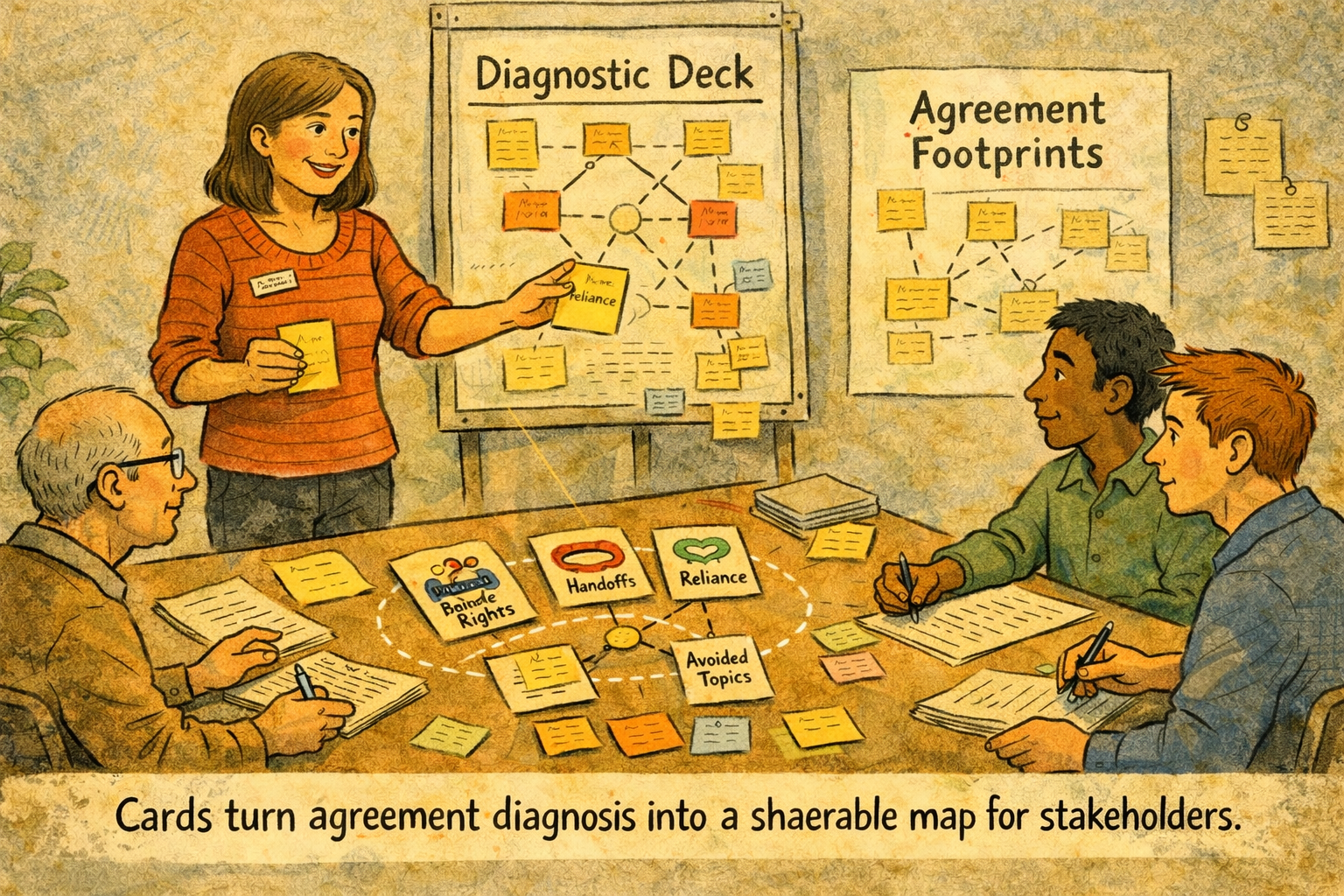
Methodologically, this vignette also marks the most granular layer of my PhD inquiry. I use the cards at the individual/role level to surface, sharpen, and test agreement footprints in short cycles, because that is where legitimacy routing, reliance, and handoff behavior becomes most observable. Those micro-level footprints become hypotheses that can be probed at the group/company level (through repeated card sessions and the Agreement Health Check as a comparable felt-experience signal) and again at the ecosystem level (through shadowing, workshops, and cross-party patterns). The point is not to scale a story; it is to scale a measurement grammar: the same footprint claims must survive contact with different roles, interfaces, and evidence types, or they get revised.
Framing question to end on: when a system says “it has to go through the right route,” is that a governance design someone is actually hosting, or a socially acceptable mechanism for keeping legitimacy person-bound and ownership ambiguous?