
The Research Spine: Agreements as Economic Infrastructure
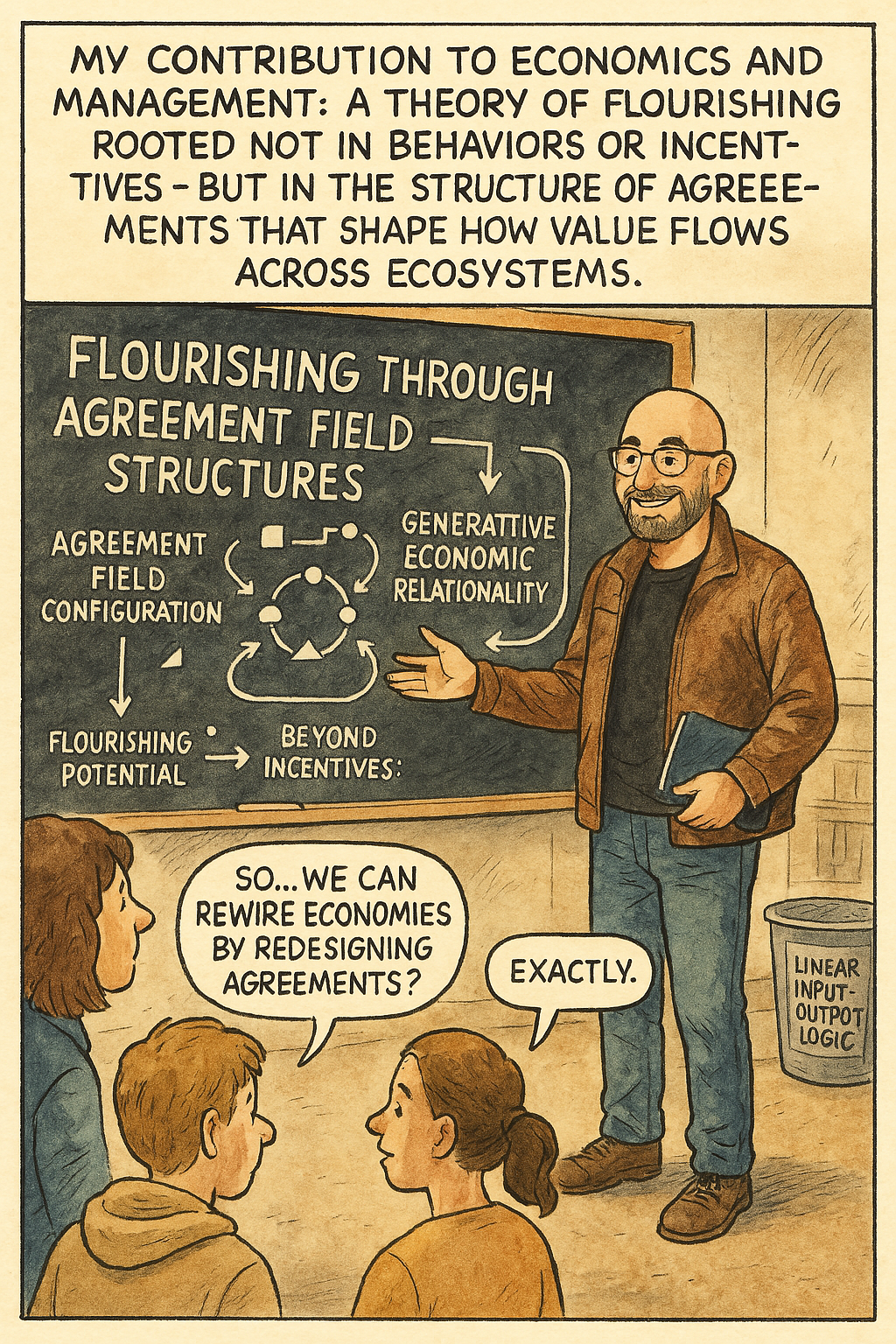
Applied economics has a measurement blind spot: we model outcomes but rarely instrument the invisible infrastructure that produces them, the enacted agreement layer that governs how work actually gets done in business ecosystems and value flows (Adner, 2017; Iansiti & Levien, 2004; Jacobides, Cennamo, & Gawer, 2018; Ritchie-Dunham, 2014). That same agreement infrastructure is also the primary mechanism through which Ecosystem-Wide Flourishing (fragility or stakeholder outcome) is produced—because it determines who gets better off, who carries the hidden costs, and whether coordination remains regenerative over time (Ritchie-Dunham, 2024; Ritchie-Dunham et al., 2025).
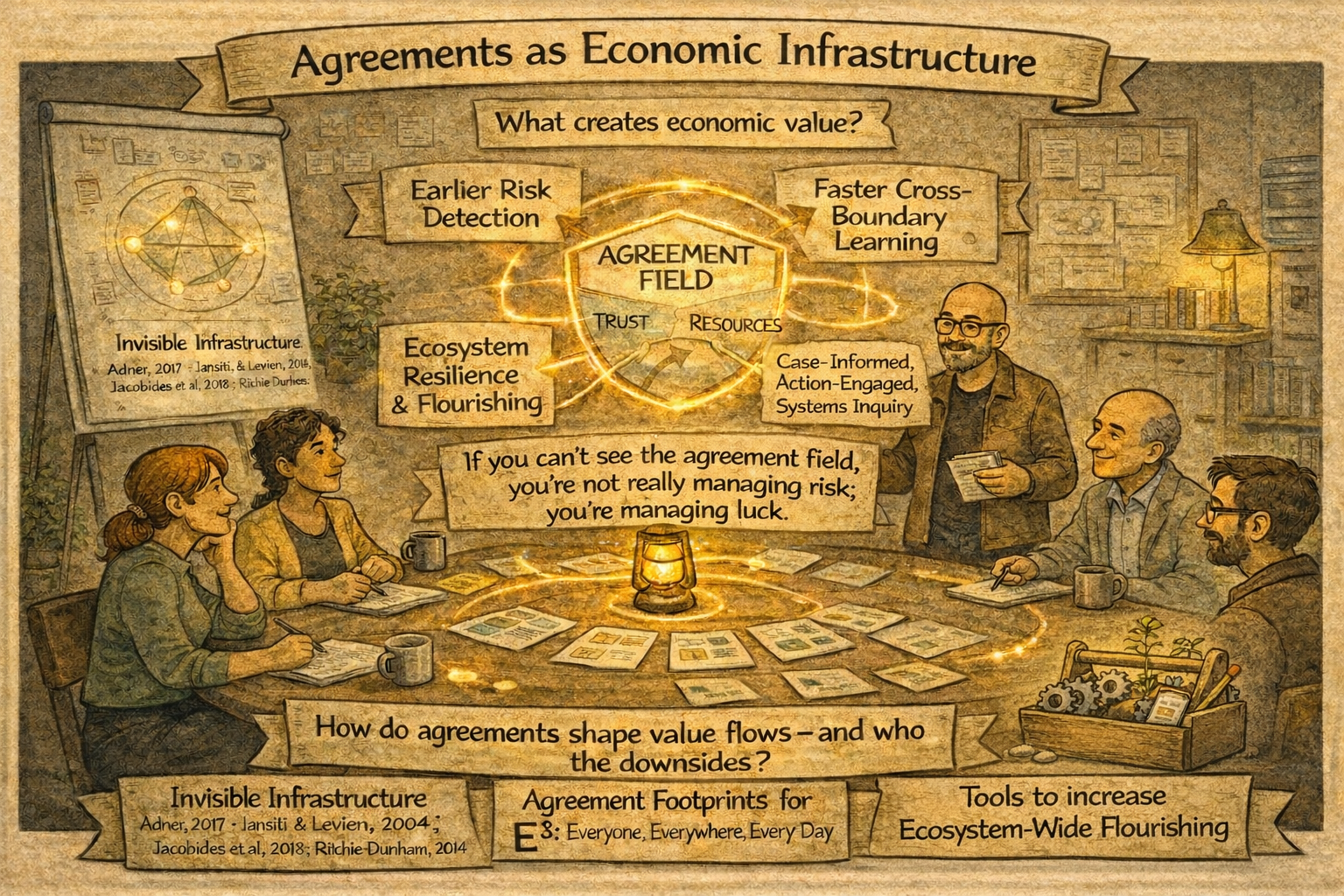
In field settings, fragility first appears as agreement debt: silent compensation, shadow work, recurring rework loops, and risk pushed to the least powerful actors. This debt can accumulate even when formal performance narratives remain plausible, because many indicators capture effects downstream—after the system has already paid the price in friction, delays, and learning loss (Phillips & Ritala, 2019). When “bridge people” leave, the hidden costs surface: slowed execution, degraded learning, and weakened ecosystem capacity to coordinate under stress (Ritchie-Dunham et al., 2024).
My PhD targets the missing layer: the agreement field—the enacted rules that determine who can decide, what counts as “quality,” and who absorbs the downside when reality hits. I operationalize this through agreement footprints (observable residues of enacted agreements) and an agreement research integrity metric, E³: Everyone, Everywhere, Every Day—a way to quantify the gap between brochure claims and lived practice (Ritchie-Dunham, 2024). This is also how “culture” becomes measurable without reducing it to feelings: footprints are evidence, not opinion.
Methodologically, this is CAESI (Case-Informed, Action-Engaged Systems Inquiry): rigorous, triangulated inquiry that builds working explanations from episodes, traces, and artifacts—strong enough for publication yet close enough to practice to remain economically relevant in complex adaptive ecosystems (Phillips & Ritala, 2019). It holds up a mirror without becoming “the fixer,” because the unit of progress is not advice but testable insight.
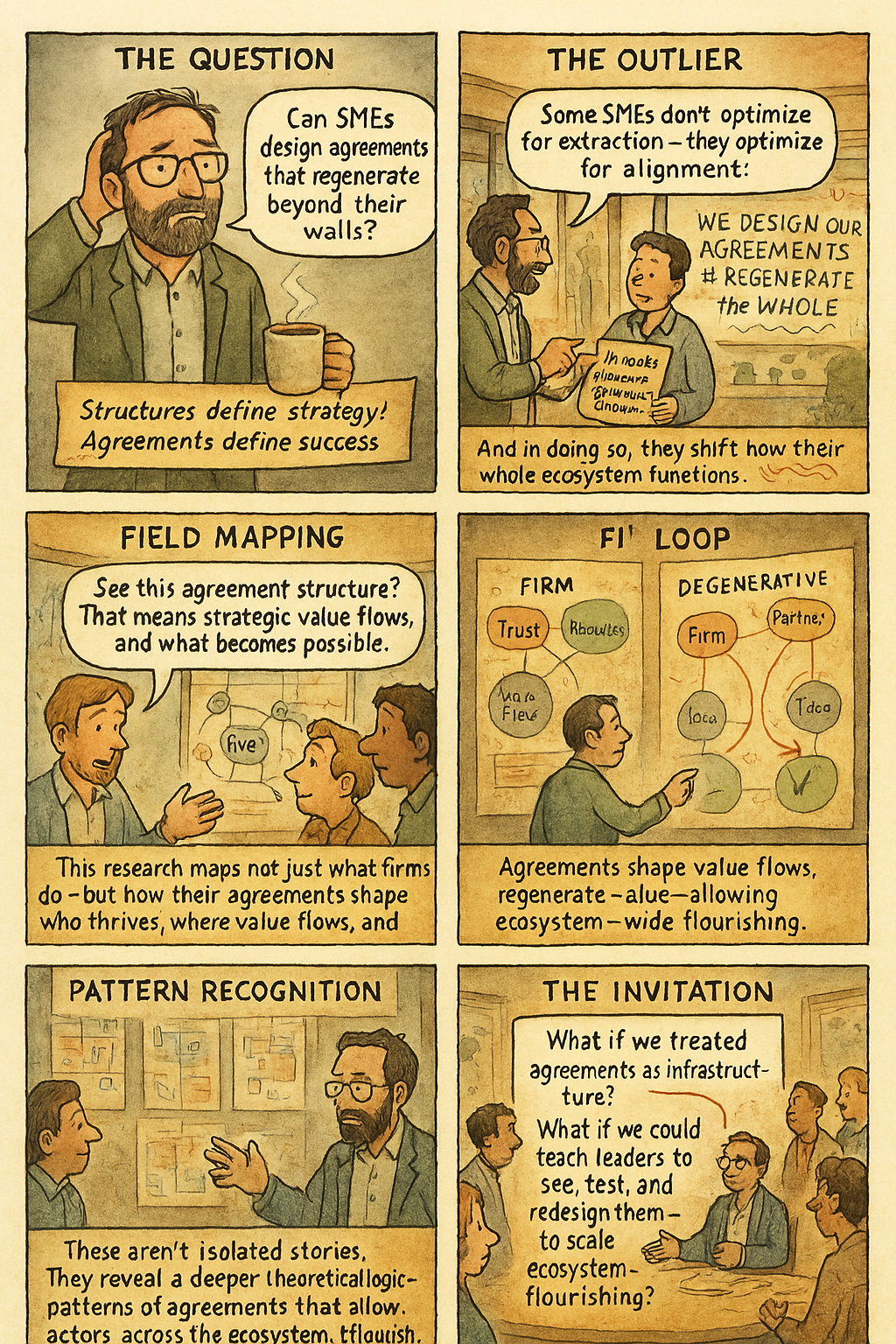
At the regional level, this becomes an applied economic contribution: earlier risk detection (before financial events), faster cross-border learning, and SME ecosystems that generate resilience rather than extraction—because the agreement field becomes measurable, discussable, and redesignable (Ritchie-Dunham et al., 2024). Concretely, the output is a regional research instrument set: a shared measurement logic that links ecosystem functioning to well-being and value generation, plus repeatable diagnostics that regional partners can use to compare patterns across sectors without imposing one discipline’s worldview on the rest (Lee, Kubzansky, & VanderWeele, 2021; VanderWeele, 2019).
References
Aguilera, H. (2025). Collaborative measurement of flourishing. In J. L. Ritchie-Dunham, K. E. Grande, K. Granville-Chapman, & M. T. Lee (Eds.), Leadership for flourishing (pp. 233–246). Oxford University Press. https://doi.org/10.1093/9780197766101.003.0014
Adner, R. (2017). Ecosystem as structure: An actionable construct for strategy. Journal of Management, 43(1), 39–58. https://doi.org/10.1177/0149206316678451
Hinske, C. (2026a). TRACE — Tracking risk via agreement coordination in ecosystems (SMEs): Applied PhD research project brief [Unpublished project brief].
Hinske, C. (2026b). Translating implicit agreements into risk metrics [Transcript]. Unpublished manuscript.
Hinske, C. (2026c). Coordination debt kills good strategy [Transcript]. Unpublished manuscript.
Iansiti, M., & Levien, R. (2004). The keystone advantage: What the new dynamics of business ecosystems mean for strategy, innovation, and sustainability. Harvard Business School Press.
Jacobides, M. G., Cennamo, C., & Gawer, A. (2018). Towards a theory of ecosystems. Strategic Management Journal, 39(8), 2255–2276. https://doi.org/10.1002/smj.2904
Lee, M. T., Kubzansky, L. D., & VanderWeele, T. J. (2021). Measuring well-being: Interdisciplinary perspectives from the social sciences and the humanities. Oxford University Press.
Phillips, M. A., & Ritala, P. (2019). A complex adaptive systems agenda for ecosystem research methodology. Technological Forecasting and Social Change, 148, 119739. https://doi.org/10.1016/j.techfore.2019.119739
Ritchie-Dunham, J. L. (2014). Ecosynomics: The science of abundance. Vibrancy Publishing.
Ritchie-Dunham, J. L. (2023). 2023 World Agreements for Ecosystem-Wide Flourishing Report. Global Pactoecographic Collaborative.
Ritchie-Dunham, J. L., & Dinwoodie, D. L. (2023). Leading towards a healthy ecosystem. Developing Leaders Quarterly, (41), 72–87.
Ritchie-Dunham, J. L. (2024). Agreements: Your choice. Vibrancy Ins, LLC.
Ritchie-Dunham, J. L., Chaney Jones, S., Flett, J., Granville-Chapman, K., Pettey, A., Vossler, H., & Lee, M. T. (2024). Love in action: Agreements in a large microfinance bank that scale ecosystem-wide flourishing, organizational impact, and total value generated. Humanistic Management Journal, 9(2), 231–246.
Ritchie-Dunham, J. L., Dinwoodie, D. L., & Maczko, K. (2025). Organizational ecosystems of flourishing: Measuring ecosystem-wide flourishing. In J. L. Ritchie-Dunham, K. E. Grande, K. Granville-Chapman, & M. T. Lee (Eds.), Leadership for flourishing (pp. 139–153). Oxford University Press.
Ritchie-Dunham, J. (2026). When net-positive stalls: Why fragmented metrics keep practitioners stuck, Reflections of a Pactoecographer [Blog post]. https://jimritchiedunham.wordpress.com/2026/01/19/when-net-positive-stalls-why-fragmented-metrics-keep-practitioners-stuck/
VanderWeele, T. J. (2019). Measures of community well-being: A template. International Journal of Community Well-Being, 2, 253–275. https://doi.org/10.1007/s42413-019-00036-8
Key Definitions
-
In Jim Ritchie-Dunham’s ecosynomics framing, an agreement is “a set of implicit and explicit values that guide an interaction between two or more people,” and it is in force the moment people enter an interaction—whether or not they are fully aware of it or have explicitly consented (Ritchie-Dunham, 2023). In practice, agreements function as the enacted “rules of engagement” that shape coordination: they specify what people treat as legitimate or relevant, how they interpret situations, what counts as acceptable quality, who can decide what, how exceptions and conflicts are handled, and how burdens/benefits and consequences are distributed (Ritchie-Dunham, 2024). Because many agreements are tacit, Ritchie-Dunham emphasizes studying them through evidence in practice—recurring behaviors, structures, and processes—so that claims about “how we work” can be checked against observable traces and triangulated across interviews, group conversations, observation, and documents (Ritchie-Dunham et al., 2014).
-
Agreement debt is the accumulated hidden cost of unworkable/fragile agreement structures—showing up first as coordination friction (e.g. rework loops, stalled decisions, ad-hoc exception handling, silent compensation, dependency on bridge people) long before it becomes a credit event. (Hinske, 2026a; Hinske, 2026c)
-
The agreement field is the “missing unit of analysis”: the enterprise (and its ecosystem ties) understood as a field of enacted agreements that can be observed through three downstream views—purpose/narrative pull, lived workability/experience, and operational & financial outputs. (Hinske, 2026a; Ritchie-Dunham, 2026)
-
Agreement footprints are observable residues of enacted agreements (patterns, not opinions): how exceptions move, where repairs accumulate, who can challenge what, how escalation works, whether learning carries forward, or how accountability is enacted in practice. (Hinske, 2026a)
-
E³ is a system integrity measure: the degree to which a stated agreement/protocol is actually enacted by everyone, everywhere, every day. The E³ gap (claim vs lived practice) is treated as measurable coordination risk exposure. (Ritchie-Dunham, 2024)
-
Ecosystem-wide flourishing (EWF) is defined as the flourishing of the key stakeholders who interact within an ecosystem of relationships—not the “success” of a single focal organization in isolation (Ritchie-Dunham, Dinwoodie, & Maczko, 2025). In this framing, flourishing is treated as whole-human well-being (e.g., physical, mental, social, moral/meaning dimensions) expressed through both lived experience and observable stability/outcomes, and it is shaped by the agreement infrastructure that governs how stakeholders actually coordinate (Ritchie-Dunham, 2024; Ritchie-Dunham et al., 2025). Measurement, therefore, shifts from internal output metrics toward whether stakeholders are better off because of participating in the ecosystem, operationalized through approaches such as Total Value Generated (TVG)—a multi-stakeholder baseline-and-change logic that normalizes “caring about people in the broadest sense” and makes ecosystem impacts legible (Aguilera, 2025; Ritchie-Dunham et al., 2024). At the leadership level, this connects directly to ecosystem health: leaders must treat the organization’s livelihood as dependent on interdependent stakeholder relationships and adopt practices that sustain (and renew) the conditions for stakeholder flourishing over time (Ritchie-Dunham & Dinwoodie, 2023; Ritchie-Dunham, 2023).
-
CAESI is a PhD-first inquiry logic that builds defensible explanations from real cases using a signal-to-evidence ladder: signal → multi-role coverage → trace checks (“documents as claims unless verified”) → footprint patterns → working explanation → conservative translation into performance/risk language → short memo + proposed test (no recommendations). (Hinske, 2026a)