From Felt Experience to Agreement Footprints: A CAESI Ladder for Diagnosing Agreement Systems
Note: This text reflects conceptual research thinking. It does not describe or assess any specific organization. Examples and situations referenced are synthetic or composite and are used solely for analytical purposes.
What This Post Adds to the First Three
The previous notes argued that strategy rarely changes behavior when agreements remain invisible, that projects cannot carry systemic change when learning is not designed into the system, and that control breaks down when value emerges through interaction rather than execution. This post adds a practical layer: how I move from a first signal to an evidence-backed working explanation without slipping into advice-giving. It also clarifies a subtle shift in stance: in complex systems, improvement is rarely “implemented.” It is prototyped through small, testable moves that change what coordination makes possible.
Felt Experience Is a Signal, Not a Story
People hear “felt experience” and assume emotional hocus-pocus. That is not what I mean. In the Agreements Health Check (developed and validated by Jim Ritchie-Dunham), felt experience is operationalized as a yes/no: whether a situation is experienced as workable or unworkable, enabling or constraining, coherent or friction-heavy. In my work, that yes/no is not the conclusion. It is the starting point.
A Ladder, Not a Toolkit
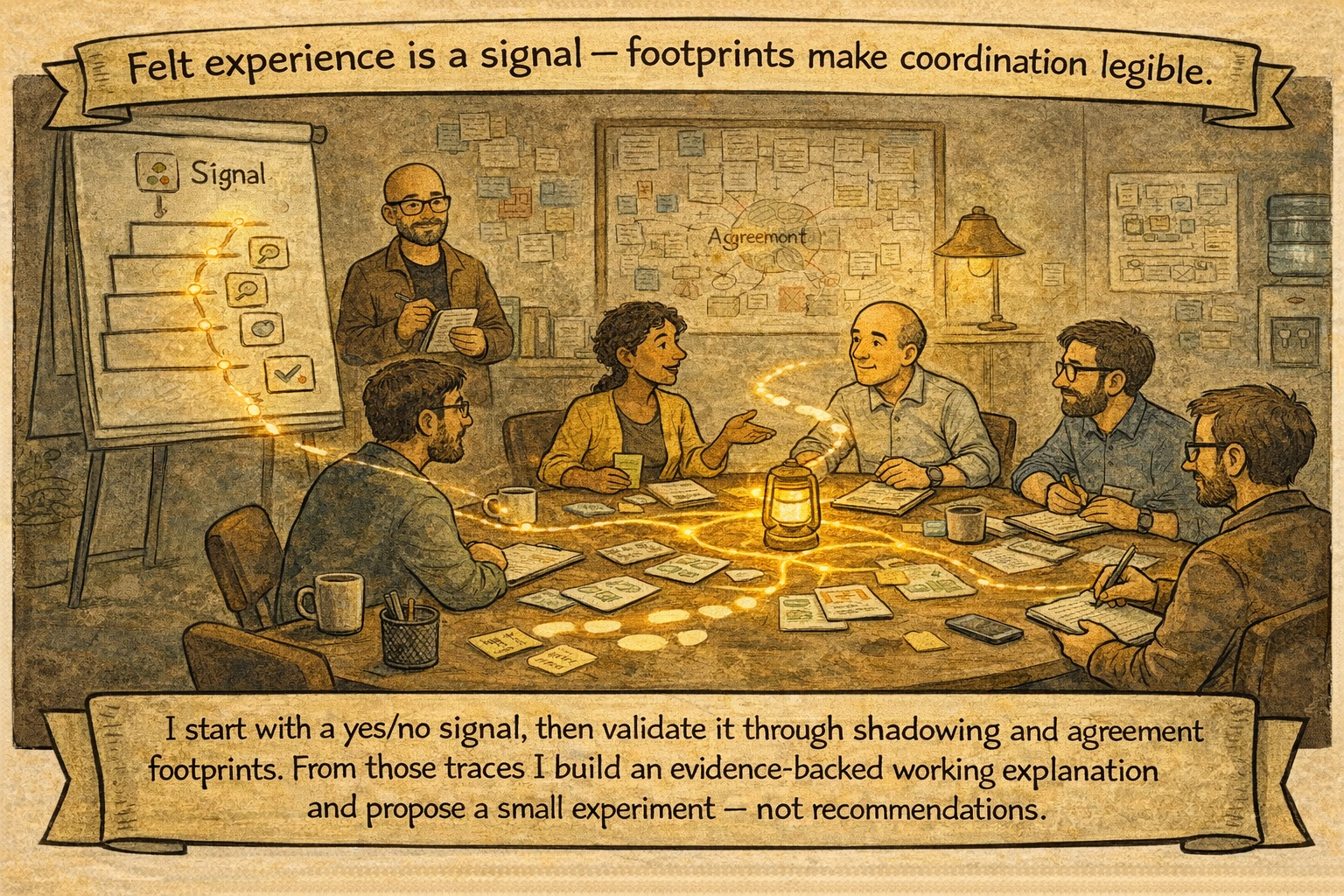
My method is easiest to understand as a ladder: I start with the group’s felt experience (yes/no), then validate and locate it through observation and interaction, and then infer the agreement system that makes the experience predictable. From there, I use the inference to clarify the gap between nominal and de facto goals, translate what I find into performance language (risk, opportunity, cost), and return an evidence-backed working explanation that invites the organization to test assumptions. This method does not claim to give finite answers; it produces evidence-based working explanations of what lies beneath the surface and shapes behavior, outcomes, and experience. The point is not to “apply a solution.” The point is to make the system’s current coordination logic legible enough that the next step can be designed as a small experiment rather than a belief-based initiative.
Why Shadowing Matters
If felt experience is the starting signal, shadowing is where the signal becomes diagnosable. A great deal of agreement logic never shows up in a meeting room. It shows up in handoffs, exceptions, approval patterns, uncertainty handling, and where repair work accumulates. That is why my deeper work often includes extended shadowing (spread across multiple days or weeks) and a structured reflection dialogue with mixed roles. Agreement systems do not live in one person’s intentions; they live in coordination.
Agreement Footprints: What I Actually Observe
To keep the method grounded, I use a practical term: agreement footprints. Agreement footprints are the often-invisible residues of interaction, small traces that reveal what the system reliably allows, discourages, or requires. They can be micro signals (a pause, a joke, a look), process signals (a reroute, an escalation, an exception path), or trace signals (a missing number, a repeated delay, a workaround that never becomes visible). I do not treat any single footprint as “truth.” I look for patterns that remain stable across roles, moments, and sources.
Documents Are Sometimes Claims, Not Evidence
Sometimes I deprioritize internal documents because they describe the envisioned result rather than the actual result and supporting evidence. They are often written to impress or steer, not to document reality. That does not mean I ignore them; it means I treat them as claims that need validation, as vocabulary maps that reveal how the organization talks about itself, and as pointers that help me locate concrete traces. When documents are unreliable, the replacement move is simple: I treat them as claims, verify them through shadowing, use them to locate vocabulary, and ask for concrete traces rather than narratives. This is not cynicism. It is a way to prevent future-shaping work from being built on performative descriptions rather than observable coordination reality.
Three Footprint Families I Use as a Method Spine
In practice, many footprints appear, but for my current research synthesis, three families have proven structurally sound. These are not a closed framework. They are a first set of testable distinctions that will expand as the evidence base grows.
Agreement visibility and negotiability: When agreements are negotiable, transformation is possible. The minimal observable sign is that the person owning the situation invites fundamental critique and integrates it into the decision rather than protecting the current frame. Notably, this is also captured as an item in the Agreements Health Check logic, meaning it can appear both as a felt experience and as observed coordination.
Identity as infrastructure: When identity functions as infrastructure, friction is reduced. The minimal observable sign is that the situation owner repeatedly brings what is being said back to purpose, value, and identity, and checks shared understanding when it is unclear: “Help us understand how what you just shared connects to our shared purpose and drives it.” In other words, identity is not branding; it becomes a coordination device.
Embedded learning loops: When learning loops are embedded, risk is reduced. The minimal observable sign is that insights from previous sessions serve as the starting point for the next session. There is a cumulative buildup, and people can track the step change together. Learning becomes a property of the system, not an episodic reflection.
What I Return (And What I Refuse to Return)
My typical output is a short memo that varies with what I find, but it is always designed to help the organization see how its agreement system shapes performance. It usually includes the top tensions that structure daily coordination, the financial risk or opportunity implied by those tensions (with evidence), the assumptions that appear to govern decisions and behavior, an invitation to refine those assumptions rather than accept mine, and a proposed next-step experiment. It does not include what most organizations expect: recommendations. I refuse to offer recommendations because they turn diagnosis into a commodity and replace shared seeing with borrowed certainty. This work is not pitching. It is a diagnosis, evidence, and an invitation to a more serious conversation about what is actually governing outcomes.
Why This Matters for the PhD
If the previous blogs were about why strategies, projects, and control break down, this one is about how I make that breakdown observable without reducing it to talk about culture or leadership. Felt experience gives the signal, agreement footprints make the system legible, and triangulated inference turns legibility into an explanation you can test. And once the system is readable, “designing futures” becomes less about vision statements and more about what small, testable shifts in agreements can make possible next.