
Agreement Card Deck
A practical prompt deck to make agreement systems visible and discussable—inside an SME and across its stakeholder field—without turning the conversation into scoring or “performance theatre.” The deck is built for disciplined inquiry: observable agreement footprints → testable assumptions → micro-experiments.
-
This deck is an applied adaptation of James L. Ritchie-Dunham’s work on agreements and agreement structures, developed through the Institute for Strategic Clarity (ISC) and Jim’s writing over many years. I’ve been using and studying this body of work since 2008 and built this deck to make the underlying ideas usable in SME field conversations and shadowing. Any simplifications, framing choices, or errors are mine.
-
Ritchie-Dunham, J. L. Agreements: Your Choice (ISC). Institute for Strategic Clarity (link)
Agreements Evidence Map + the four lenses (resources / allocation / value/ organization). jimritchiedunham.files.wordpress.com
-
Pick one real episode (stuck decision, rework loop, missed handover, recurring stakeholder tension).
Draw one card that fits that episode and read it out loud.
Capture 2–5 agreement footprints (observable residues: behavior, timing, traces).
Write one assumption: “If X, then Y (when Z).”
Define one micro-experiment: owner + action + time window + observation signal + stop rule.
Stop after three micro-experiments—or when new cards stop producing new footprints.
-
No scoring. No evaluation. No advice. This produces hypotheses and tests, not recommendations.
Use roles, not names. Don’t publish company-specific notes without explicit permission.
Treat documents as claims until verified via footprints in practice.
Content on this site is shared under CC BY-NC-ND 4.0 (copy/share with attribution, non-commercial, no derivatives).
When you share or reference this deck, please attribute:
“Agreement Card Deck (Christoph Hinske) — based on the agreements framework of James L. Ritchie-Dunham / Institute for Strategic Clarity (ISC).”
-
In a partner meeting I shadowed, the first move wasn’t a proposal. The director let the other side “download” their context, then repeated back what was heard until the definitions matched.
Before anything sounded like a commitment, constraints were named plainly (capacity, money, timing). No drama—just reality, early enough that nobody had to repair expectations later.
When the conversation drifted into “projects,” it was pulled back to identity: what we stand for, what we won’t trade away, and what that means here. That gave the group a shared decision filter in 30 seconds.
A possible next step was offered as a try, not a deal—clear enough to move, light enough to adjust. Depth of engagement matched reciprocity: transactional stayed transactional; promising relationships got more attention.
Working assumption: When sensemaking + constraints + identity are made explicit before decisions, the system prevents downstream “repair work” (renegotiations, silent compensation, rework).
Small test (2 weeks): In your next 3 partner calls, do the same sequence on purpose (sensemaking → constraints → identity → small proposal) and track: (1) follow-up clarification emails, (2) renegotiations, (3) “hidden work” people do after the meeting to make it viable.
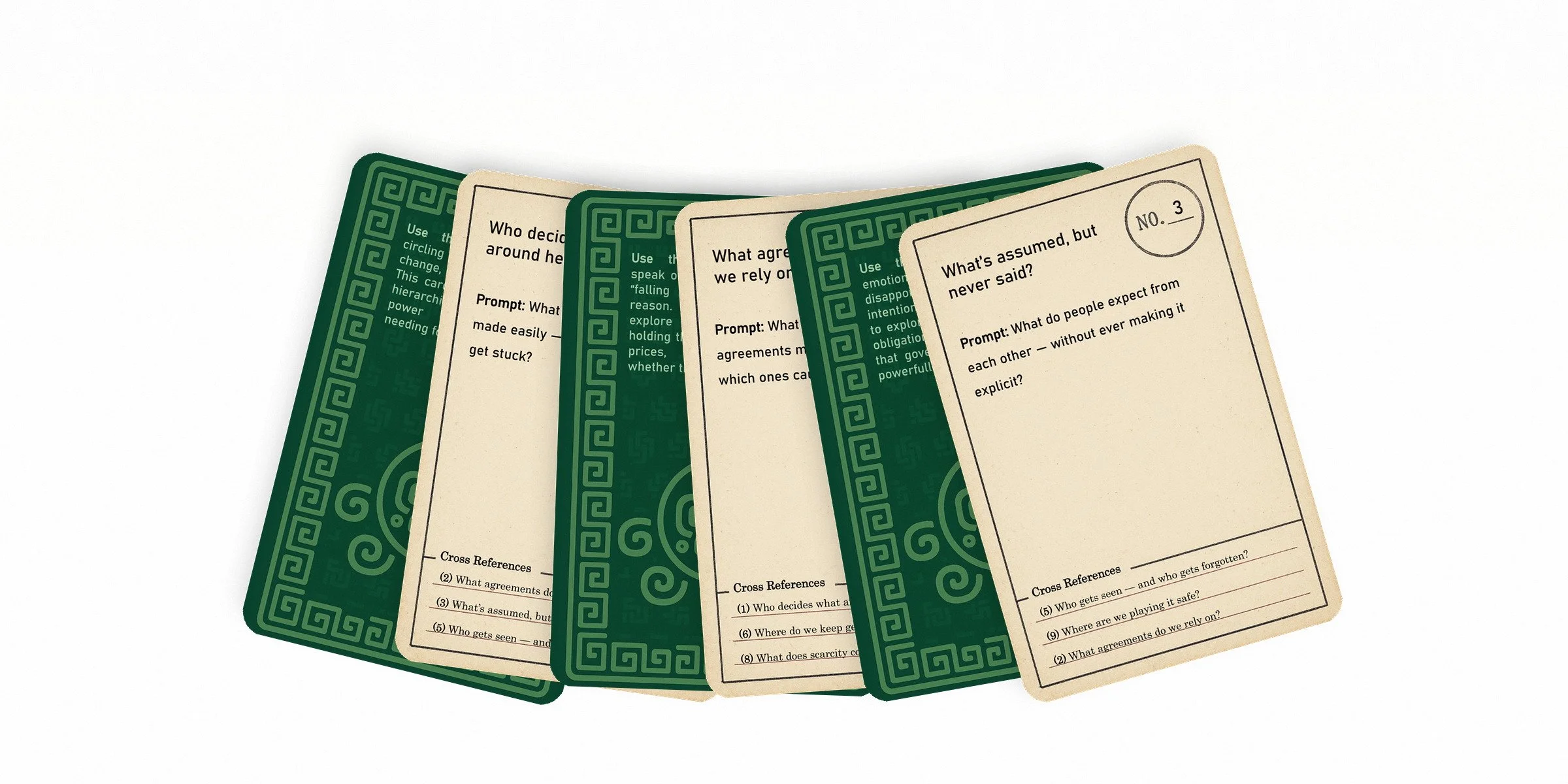
Who Really Decides?
Use this when people circle around frustration, slow change, or “surprise” decisions. This card helps surface hidden hierarchies, unclear mandates, and power asymmetries—without needing an org chart.
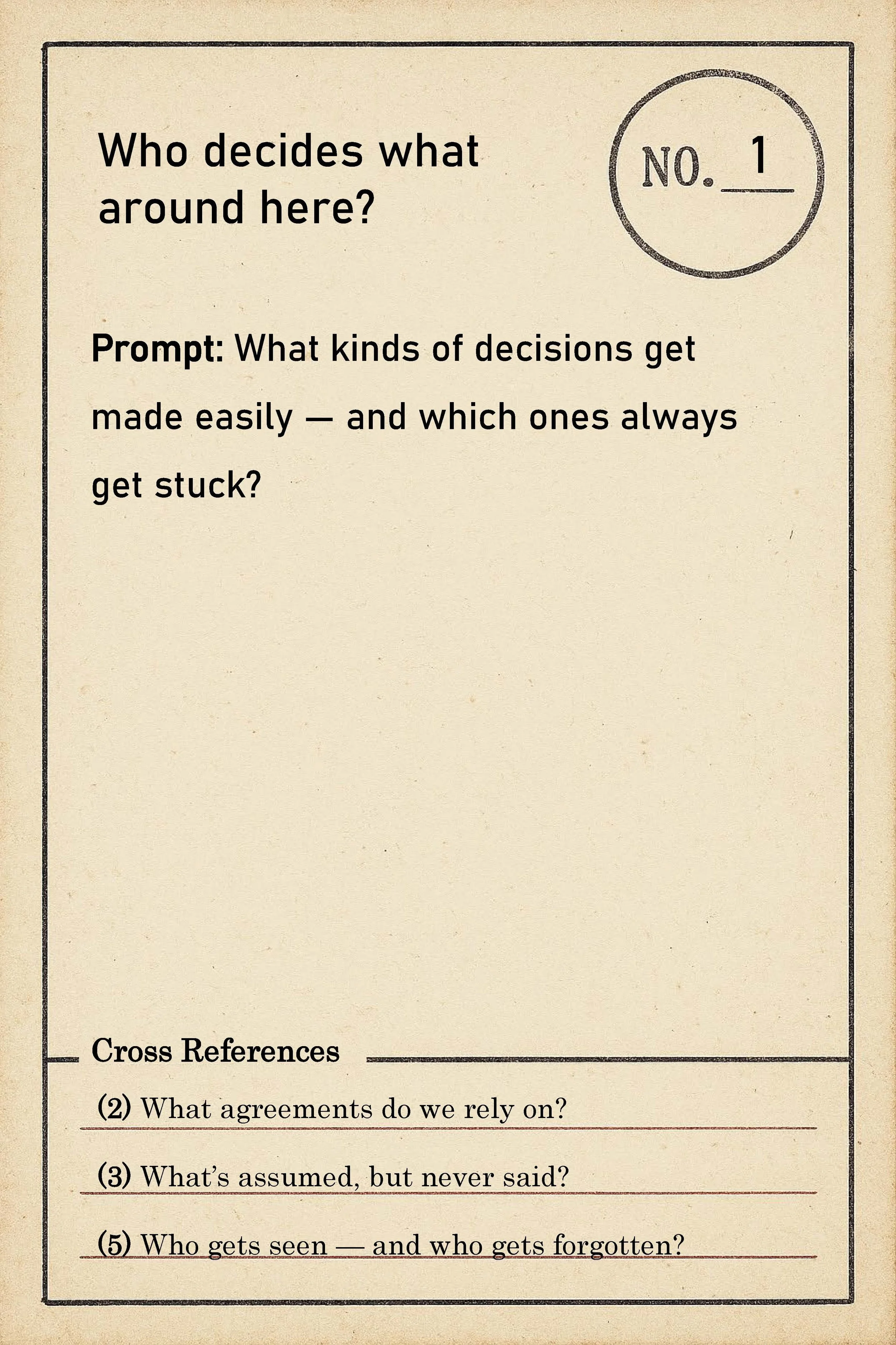
What Deal Holds This Together?
Use this when things “just work” or “fall apart,” and nobody can explain why. This card helps uncover the real deals in play—prices, promises, roles, trade-offs—and whether they still work for everyone involved.

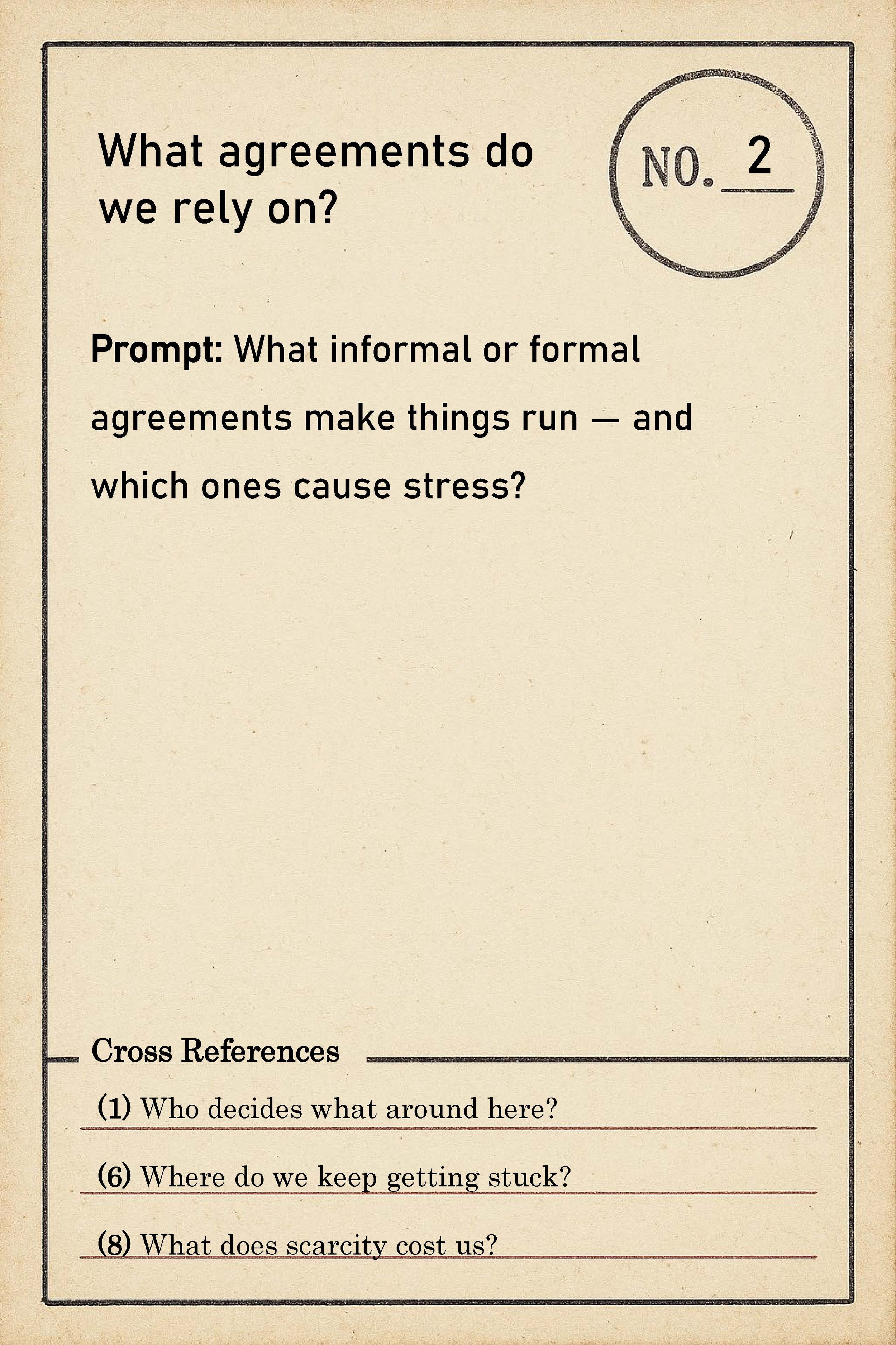
What’s Unspoken Here?
Use this when you sense disappointment, tension, or mismatched expectations. This card opens space to name tacit norms, unspoken obligations, and social contracts that quietly steer behavior.
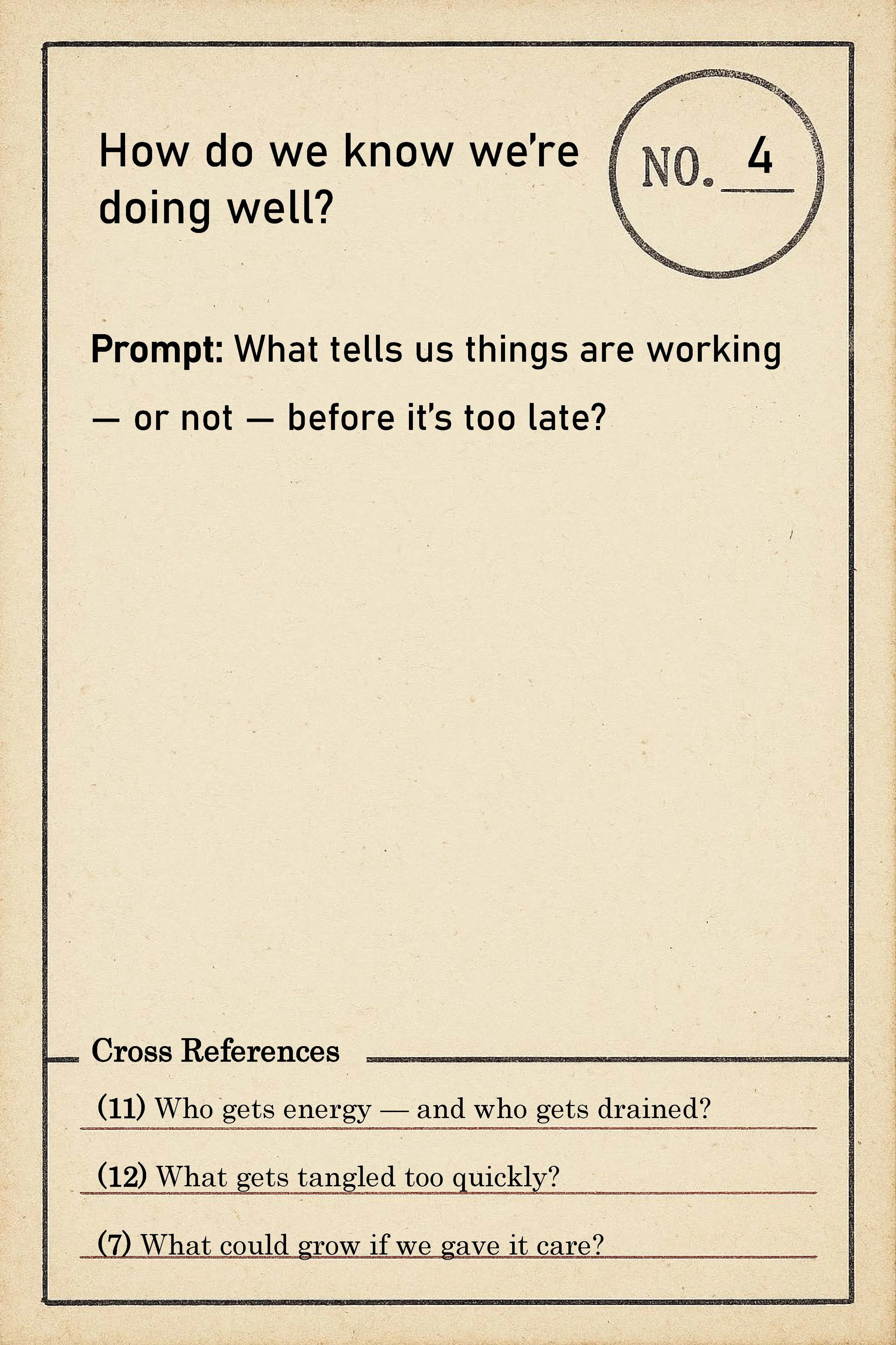
Where Do We Learn?
Use this when something fails unexpectedly, or decisions feel reactive. This card helps reveal feedback loops (or missing loops) and whether people learn early—or only after damage is done.
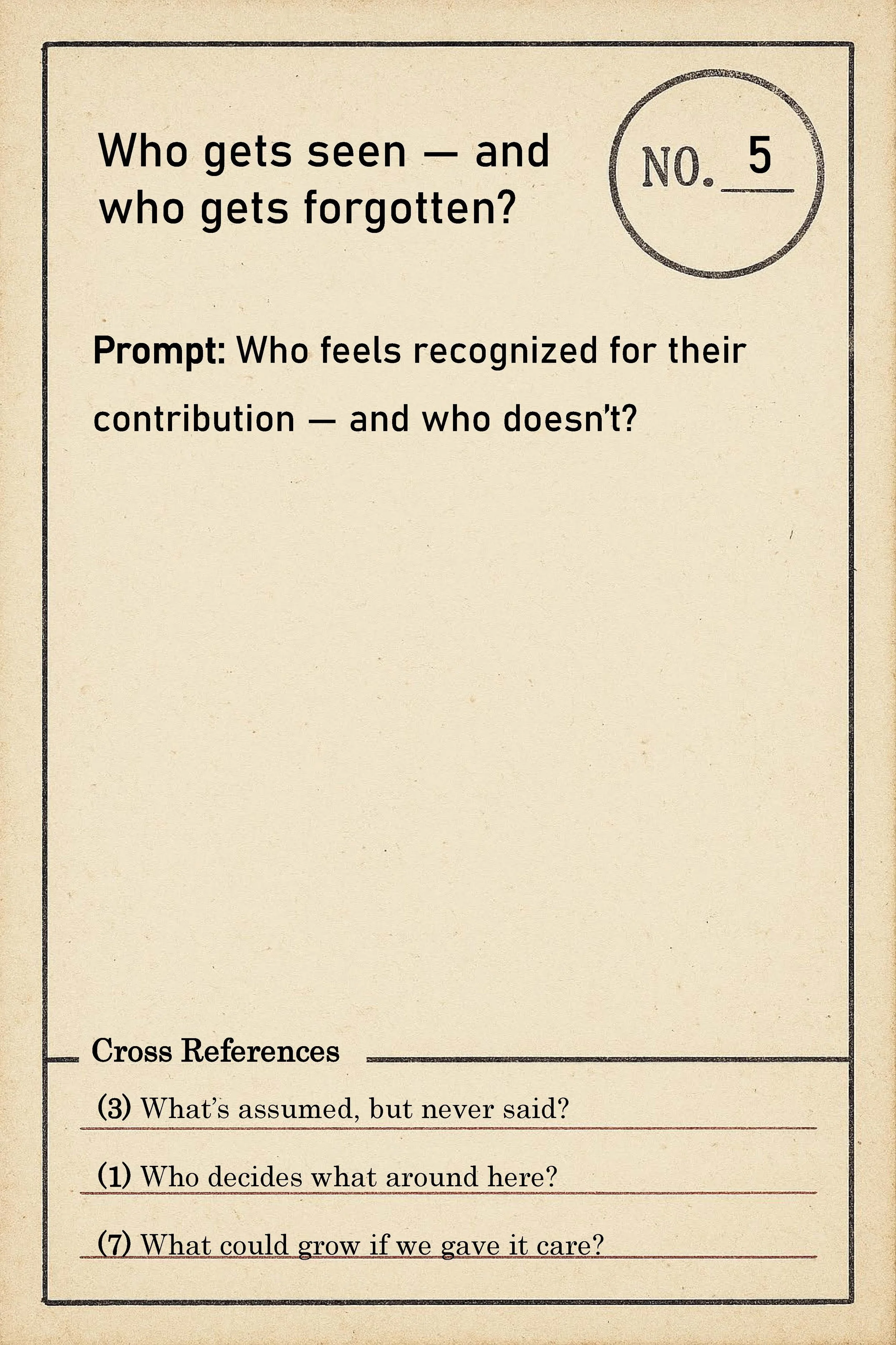
Who Carries the Load?
Use this when someone mentions dissatisfaction, disconnection, or uneven engagement. This card helps surface invisible work, missing voices, and uneven distribution of attention and rewards—without blame.
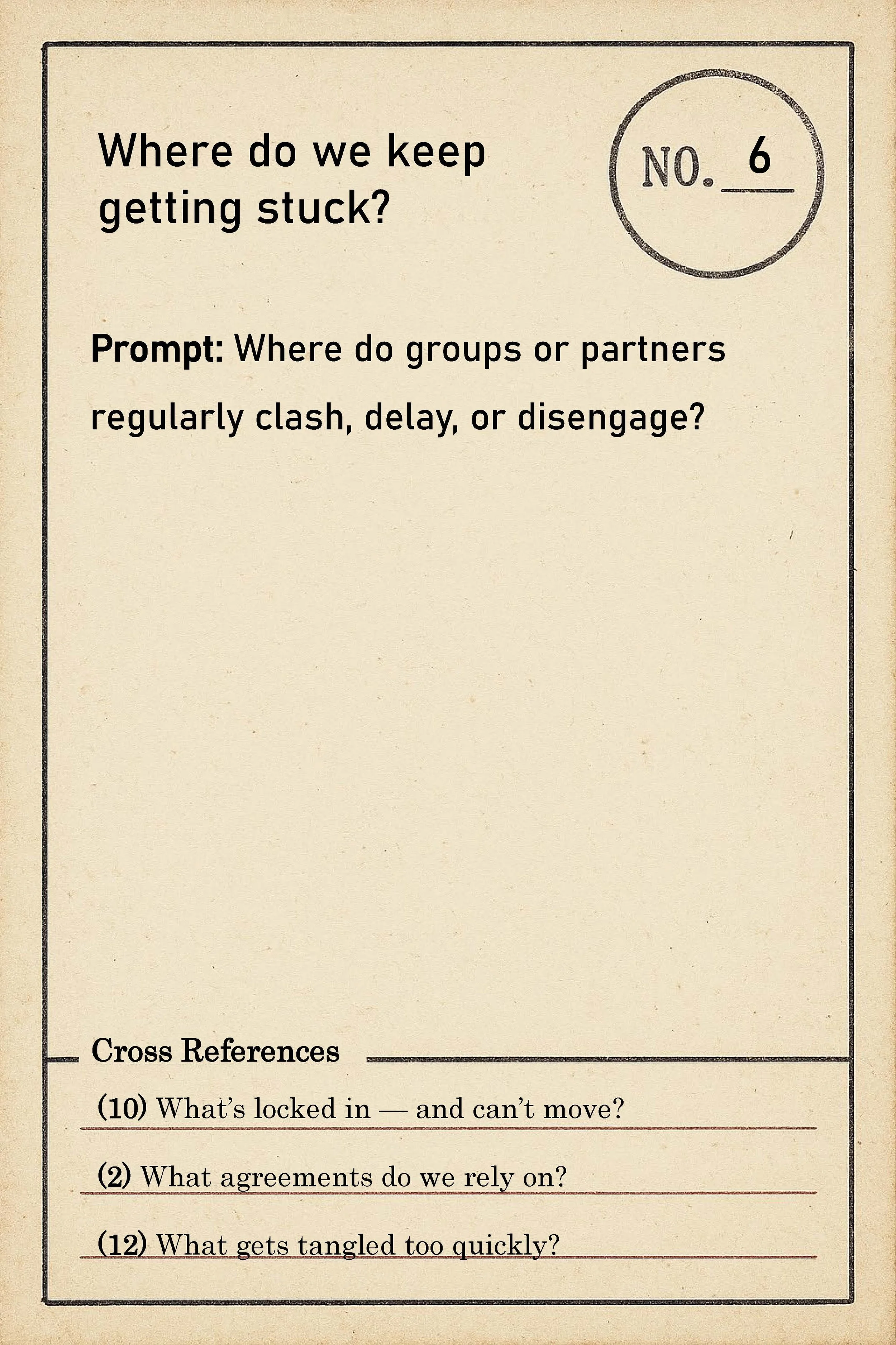
Why Does It Keep Repeating?
Use this when the same friction keeps occurring. This card helps spot structural misfits—signs that the way agreements are shaped is creating predictable trouble.
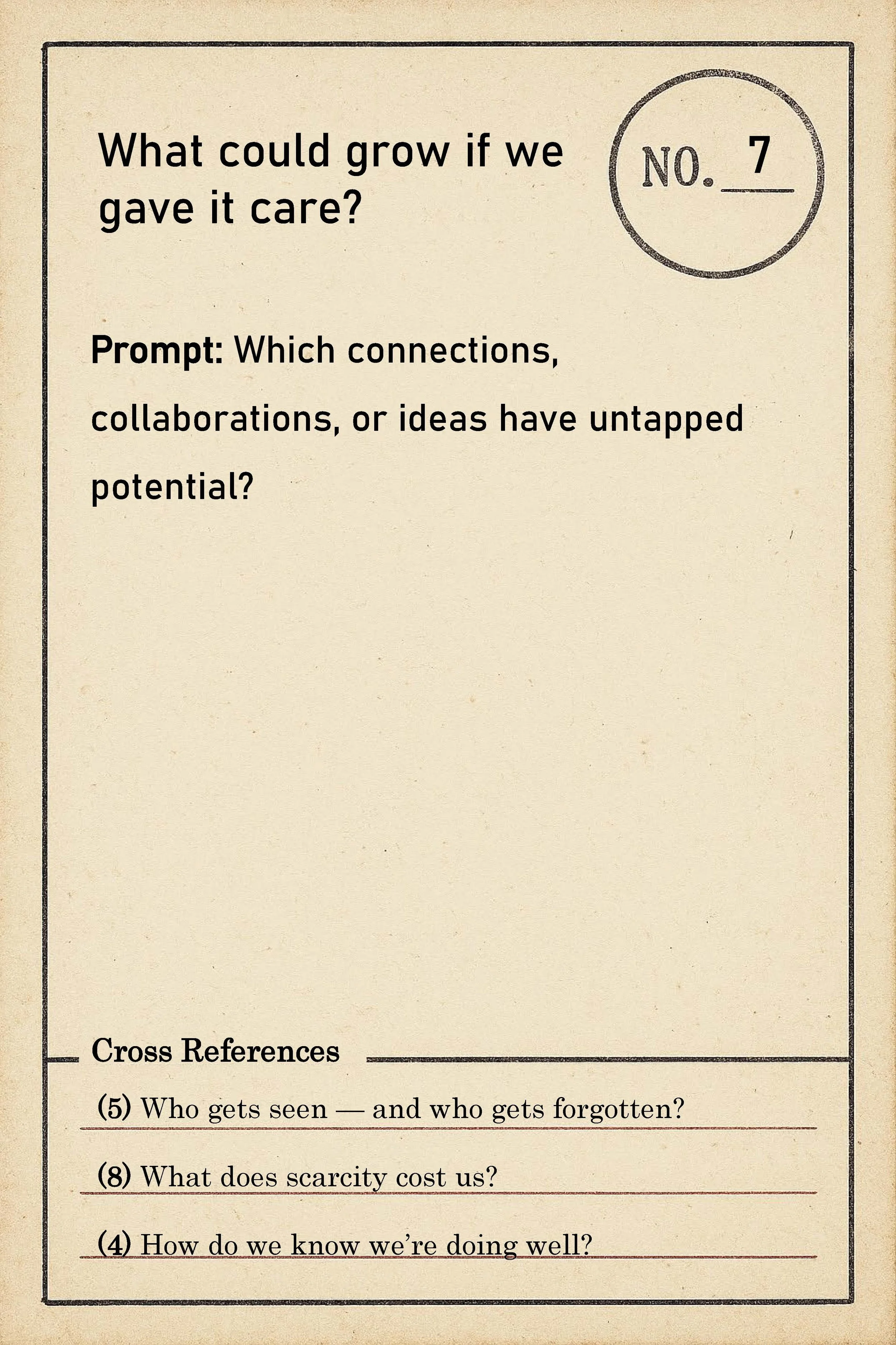
What’s Underused?
Use this when the room is ready to shift from problems to possibilities. This card helps identify dormant assets—relationships, ideas, capabilities, energy—that could regenerate value if agreements made them usable.
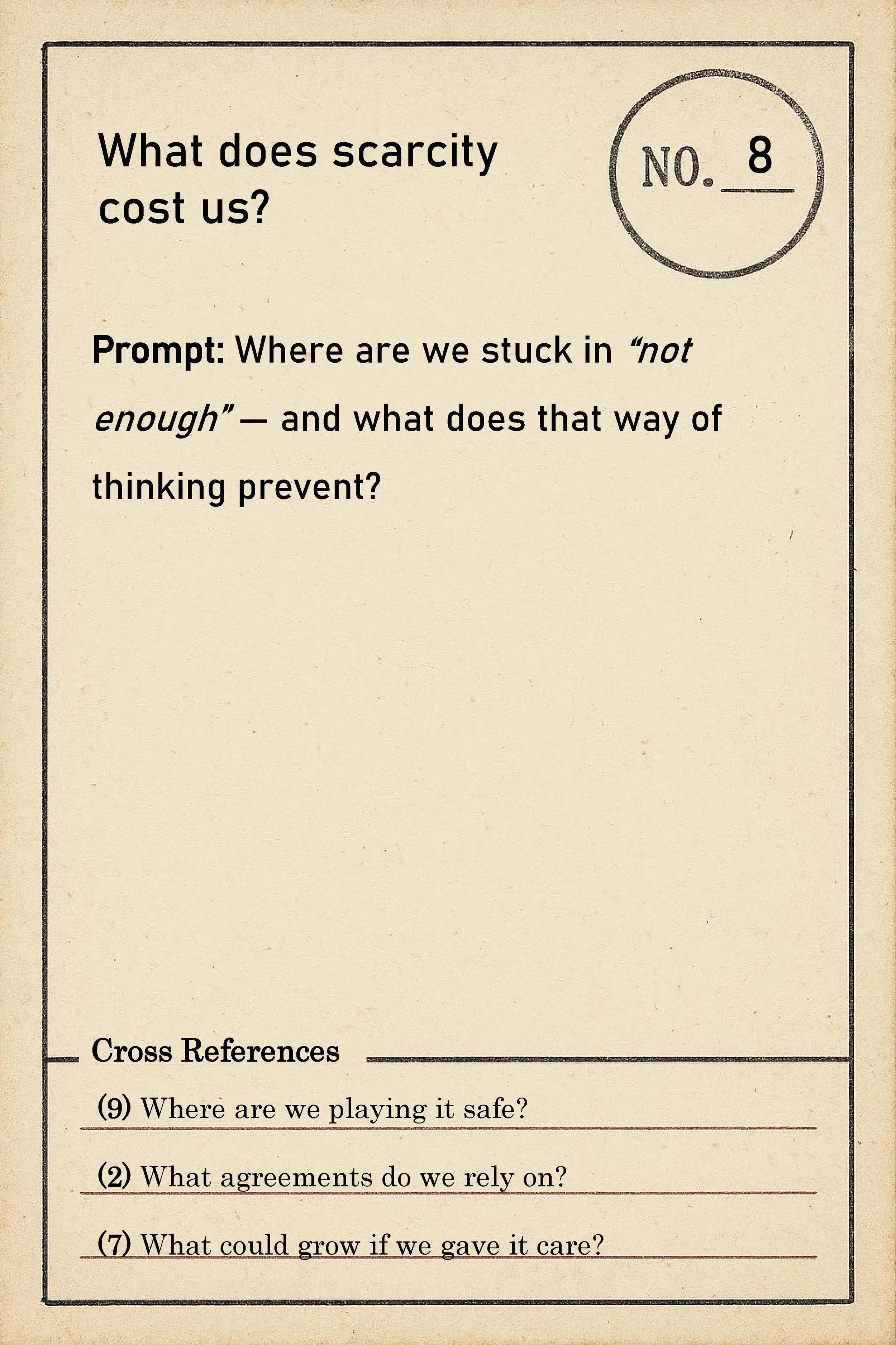
What Scarcity Story Runs Us?
Use this when you hear “no budget,” “no people,” “too busy,” or “not our job.” This card helps surface how scarcity narratives shape agreements—and what hidden costs they create (stress, missed learning, short-term moves).
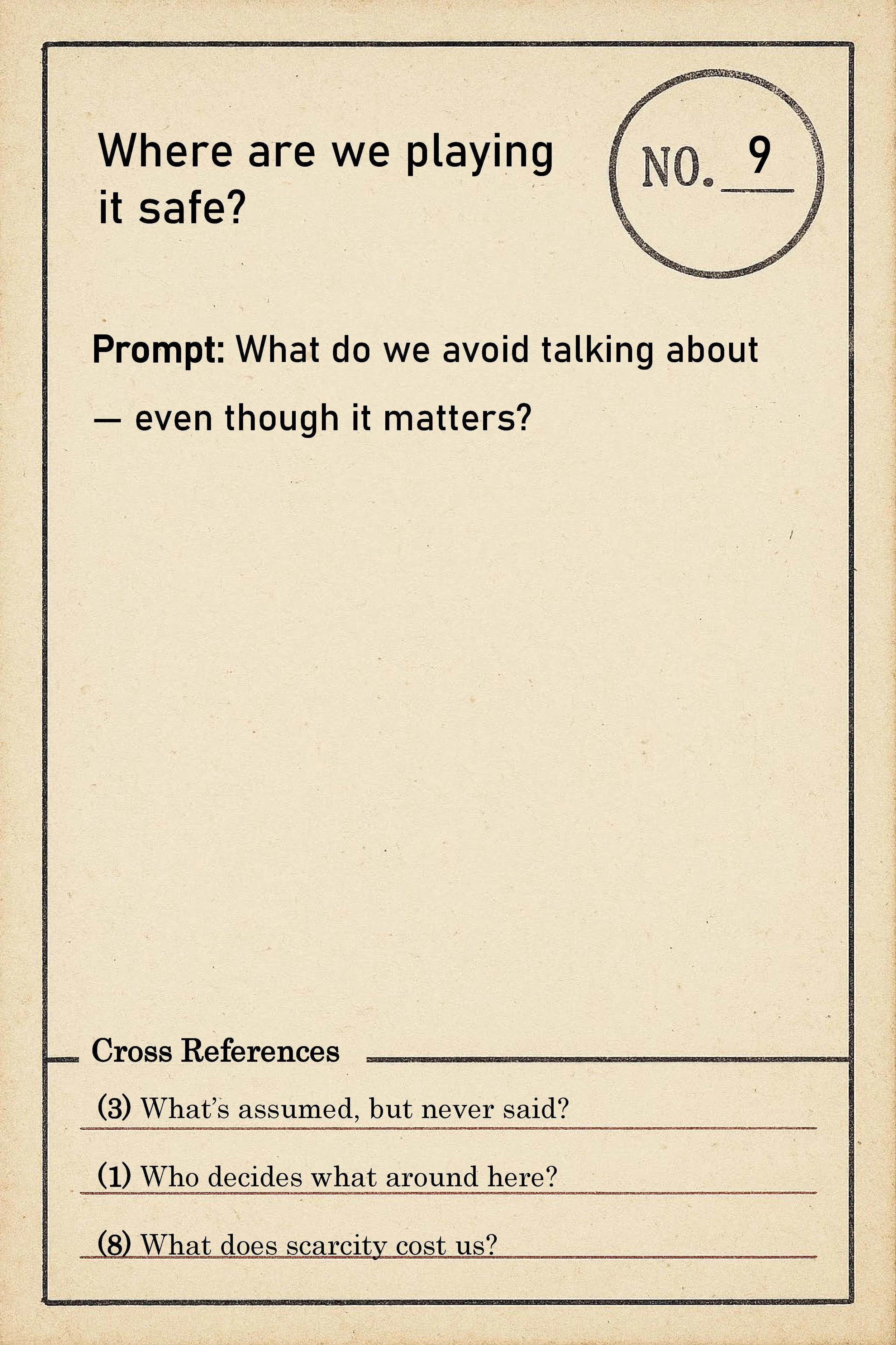
What Can’t Be Said?
Use this when there’s hesitance, avoidance, or careful silence. This card helps uncover taboos, fear, risk sensitivity, or reputational constraints that quietly limit which agreements are even thinkable.
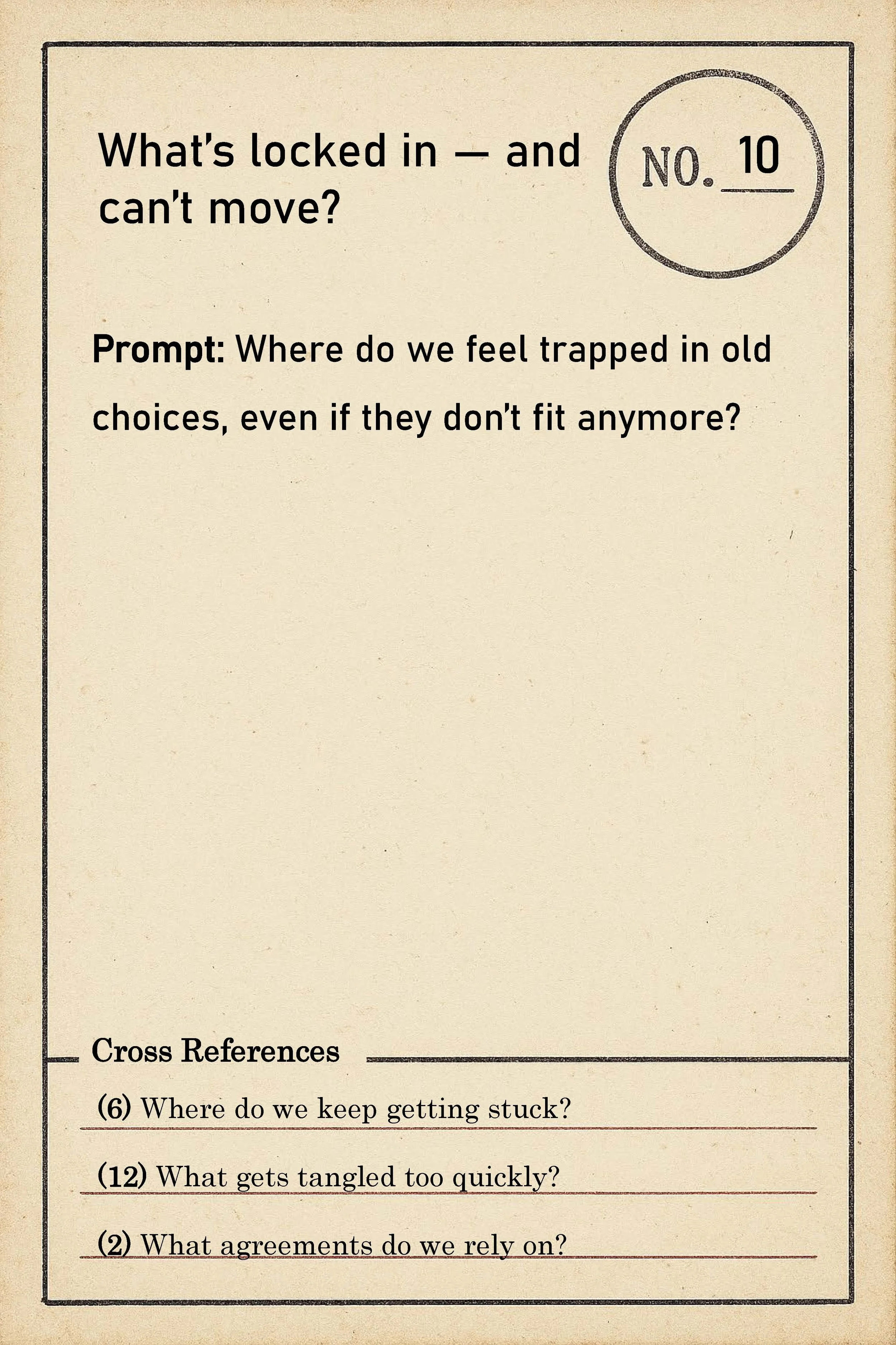
What Won’t Let Go?
Use this when you hear “that’s how we’ve always done it,” legacy partnerships, or outdated systems. This card helps surface structural inertia—agreements that once worked but now block renewal.
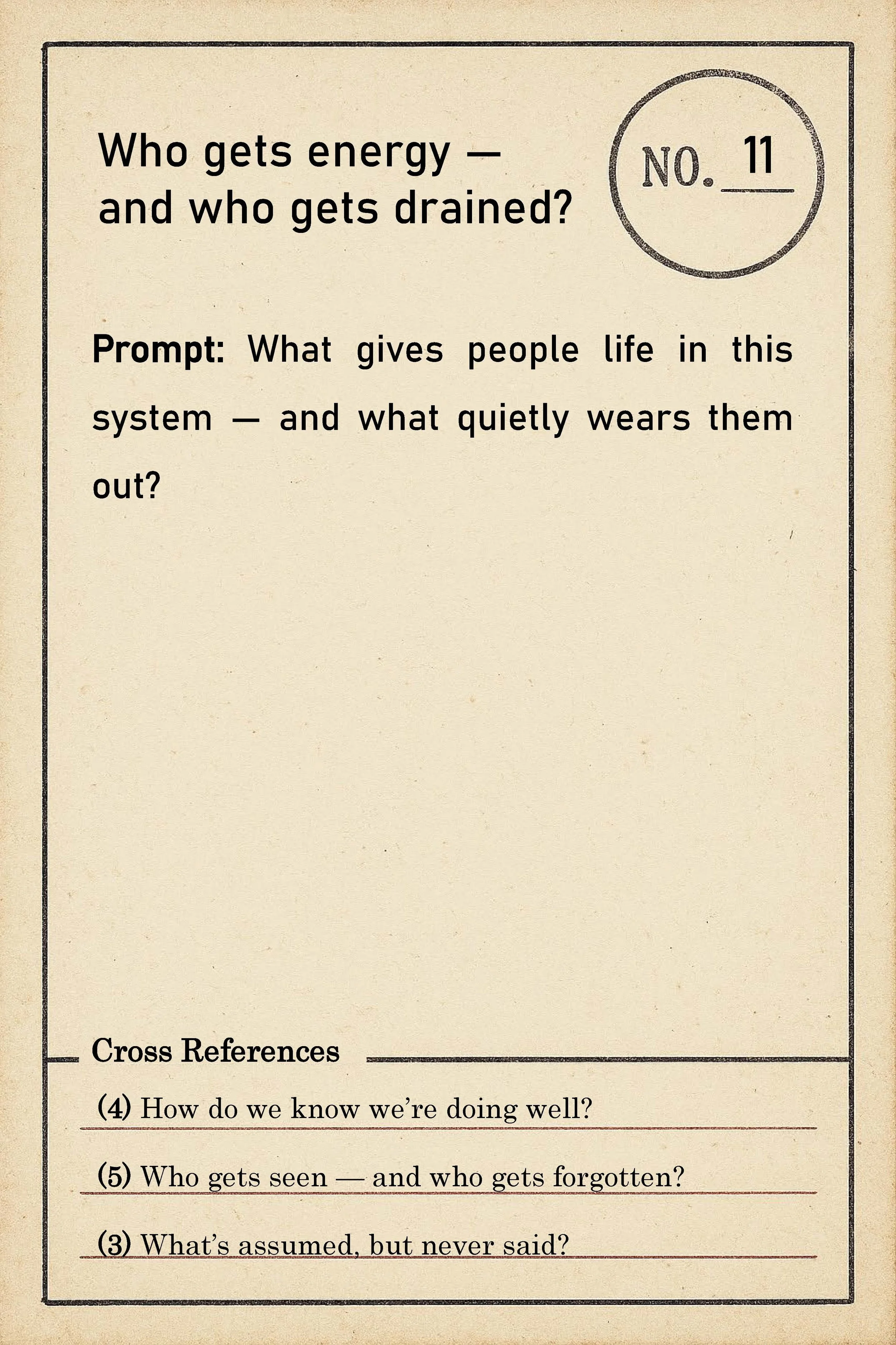
Where Does Energy Drain?
Use this when burnout, disengagement, or conflict is present. This card helps track emotional flows (not just transactions) and how agreements either protect energy or quietly consume it.
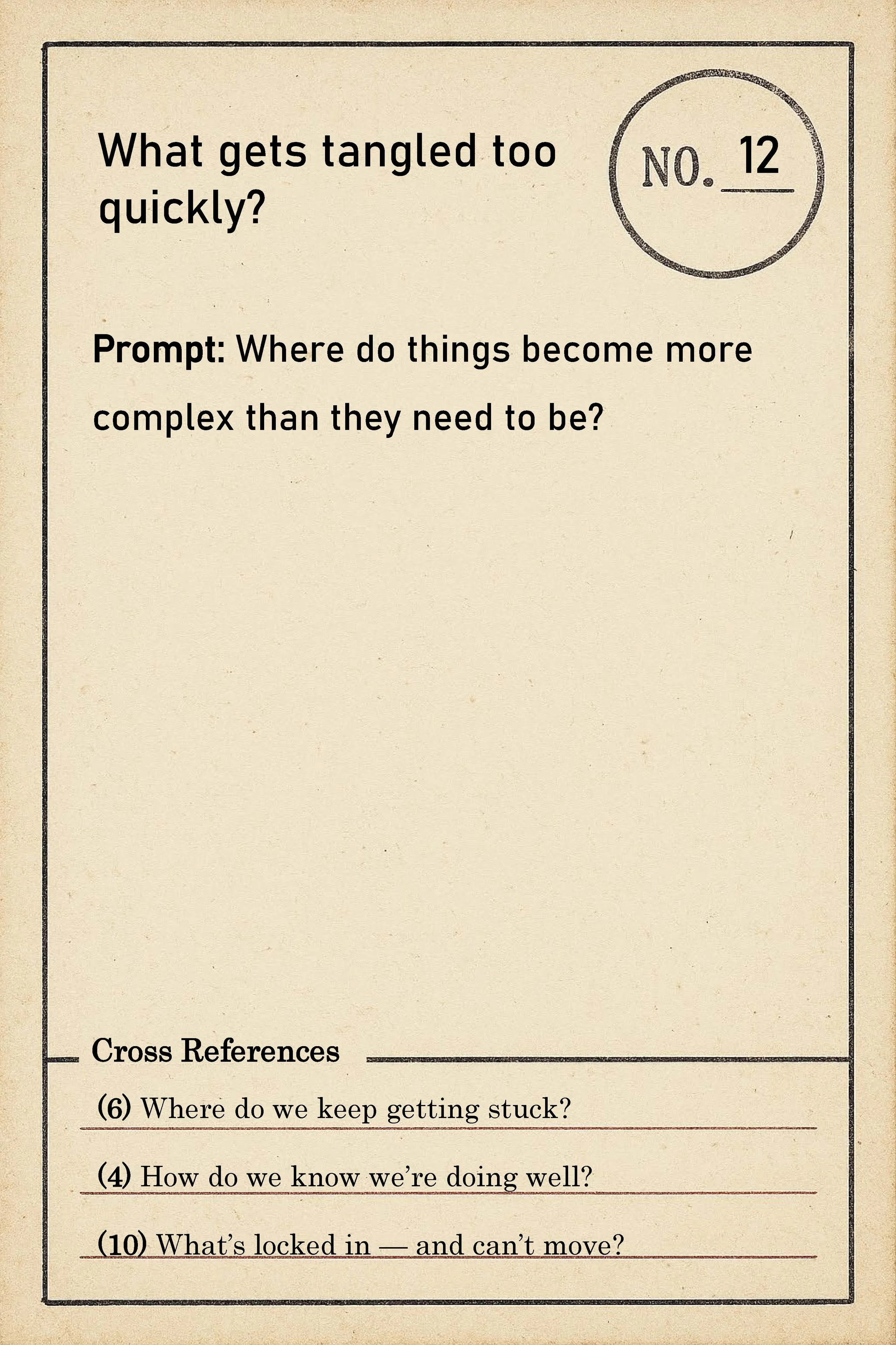
Why Is It So Hard?
Use this when coordination feels heavy: endless emails, confusing processes, or “you need a guy who knows a guy.” This card helps reveal agreement complexity that slows decisions and clouds responsibility.
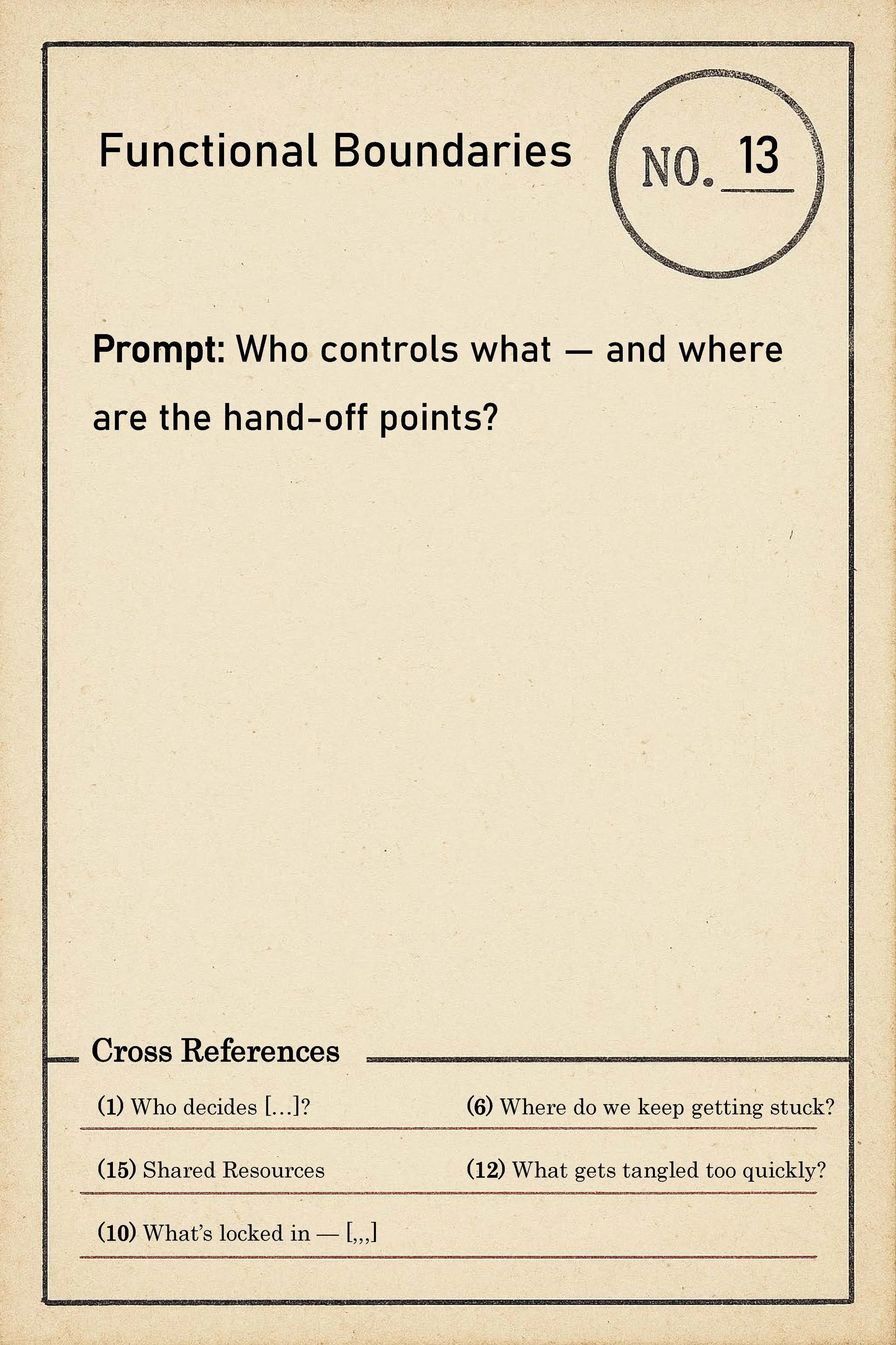
Who Owns This Work?
Use this when people argue over ownership of data, budgets, or processes—when work gets duplicated, handovers freeze (“not my job”), or essential tasks live in a grey zone with no clear remit.
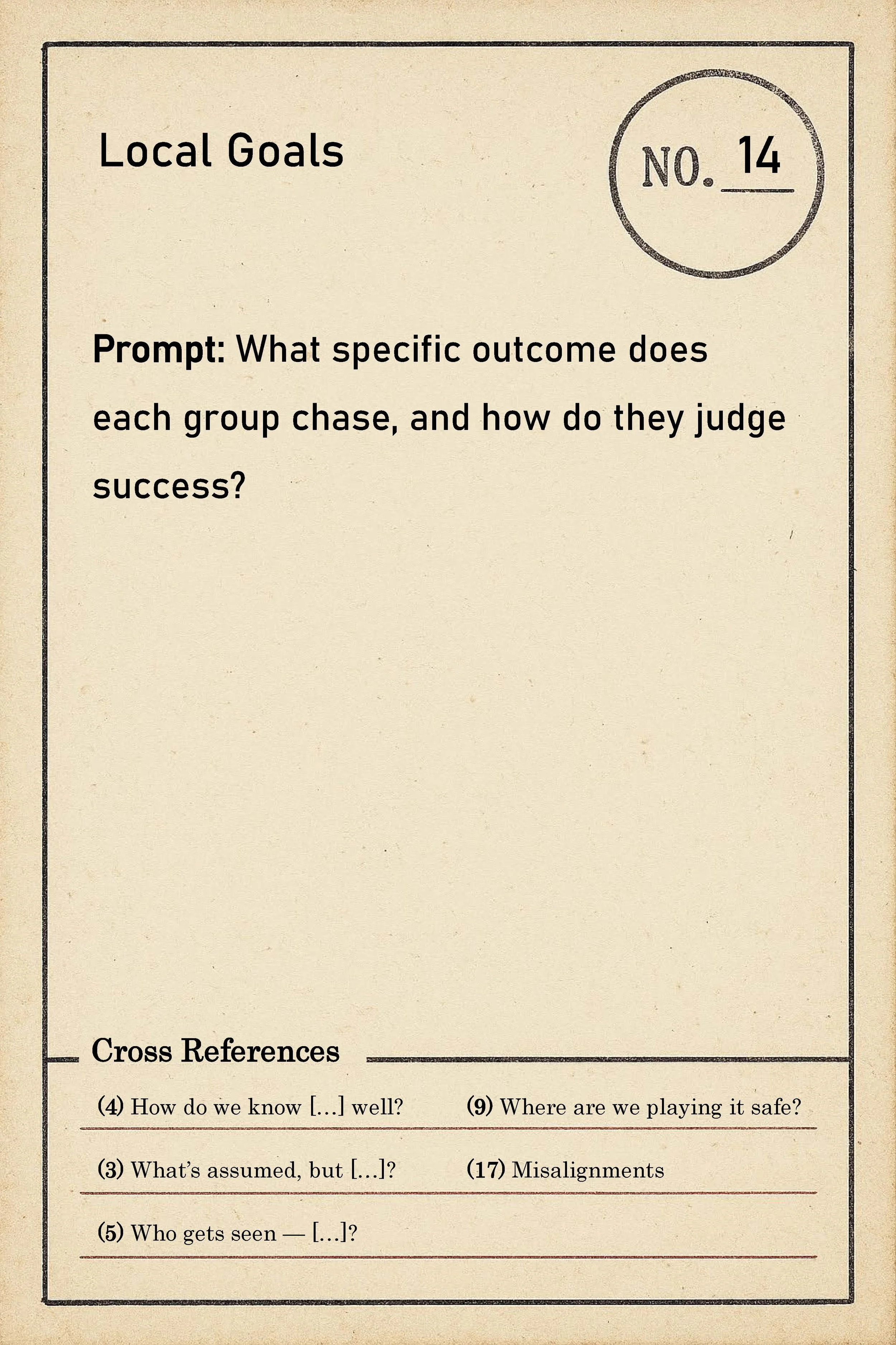
Which Scoreboard Rules?
Use this when KPIs collide, short-term wins undermine long-term health, or “success” depends on who you ask. This card helps surface competing scoreboards and the agreements behind what counts as “results.”
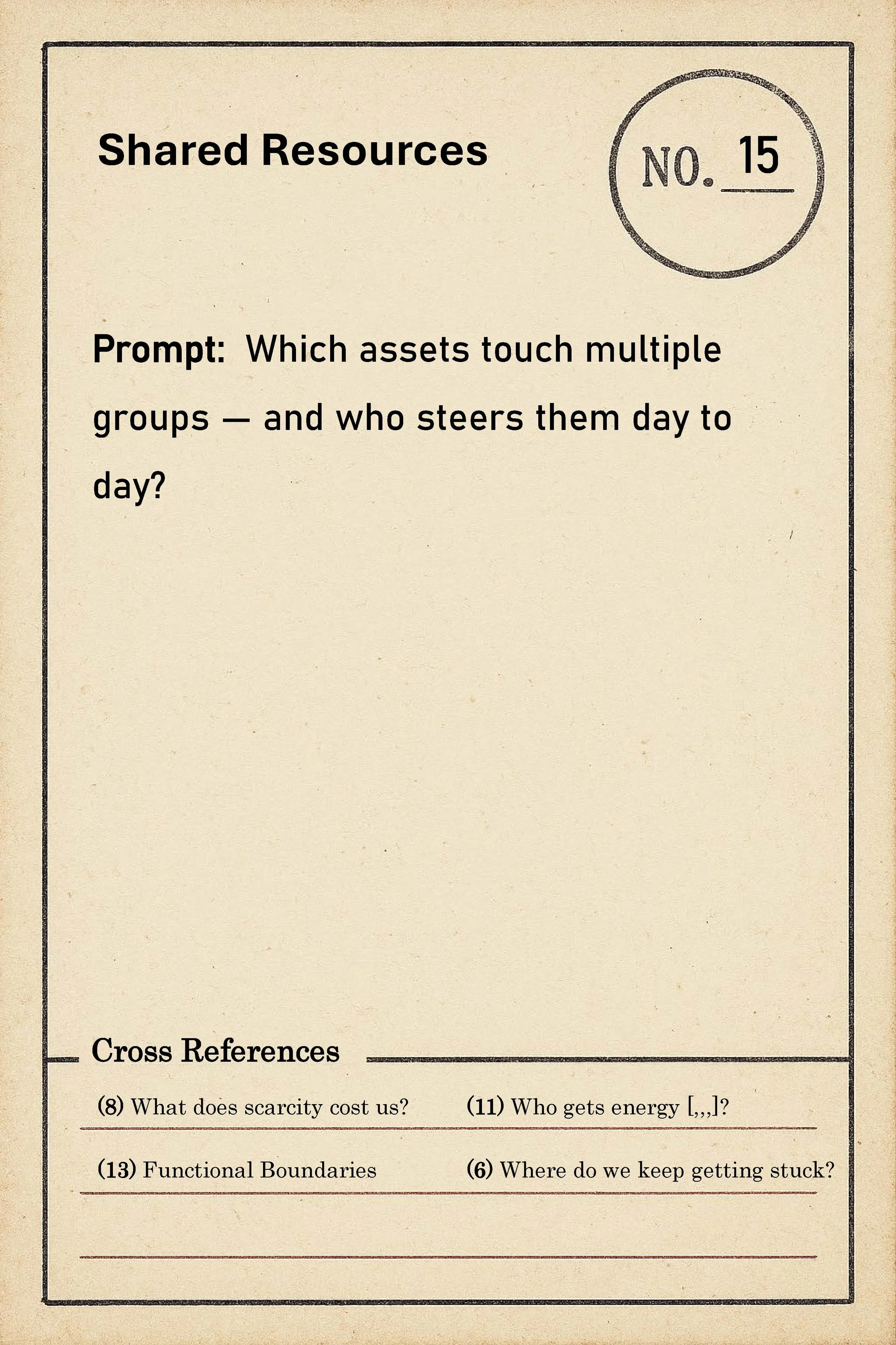
Where Is the Bottleneck?
Use this when money, staff, data, or machines become choke points. When gatekeeping slows decisions, resources get hoarded, or essential tools seem to exist “everywhere and nowhere,” creating tension and delay.
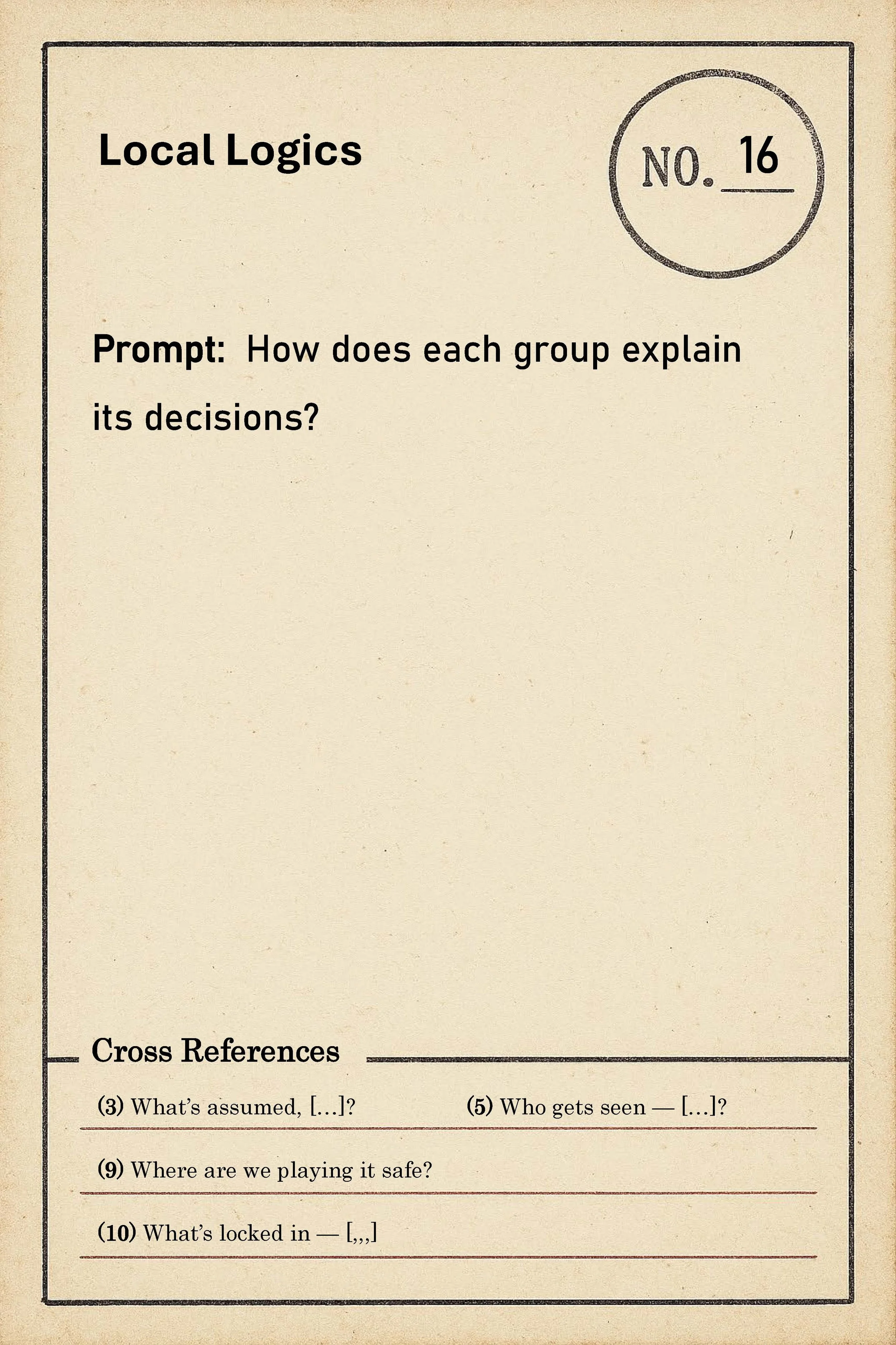
What Makes Sense to Them?
Use this when people talk past each other despite the same facts, or when a locally “obvious” choice looks irrational to outsiders. This card builds empathy for local logic—and clarifies why each corner of the system acts the way it does.
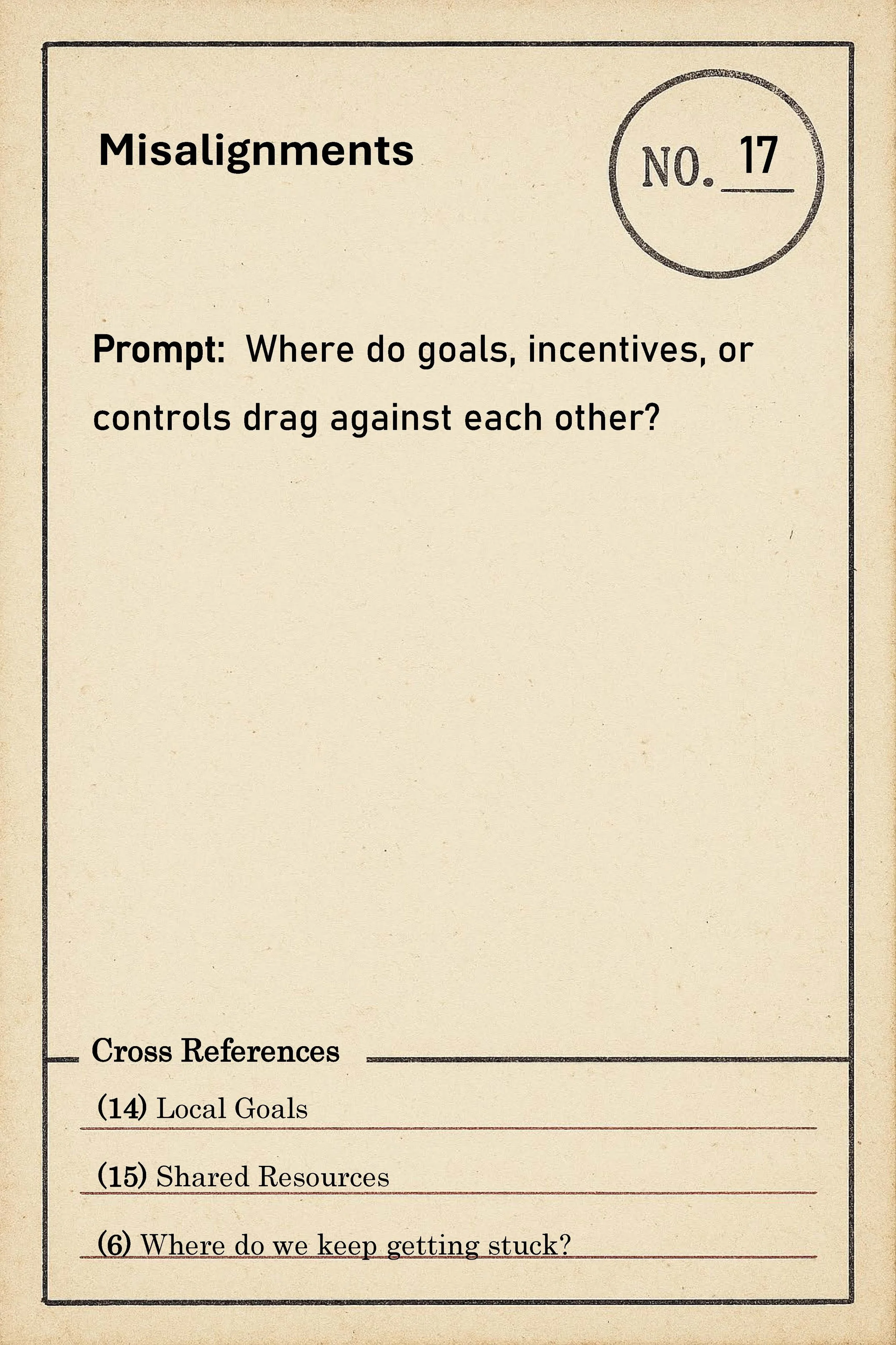
What’s Clashing Underneath?
Use this when firefighting is everyday, well-meant fixes create side effects, metrics pull teams in opposite directions, or blame cycles start. This card helps trace recurring pain back to a structural clash in agreements.
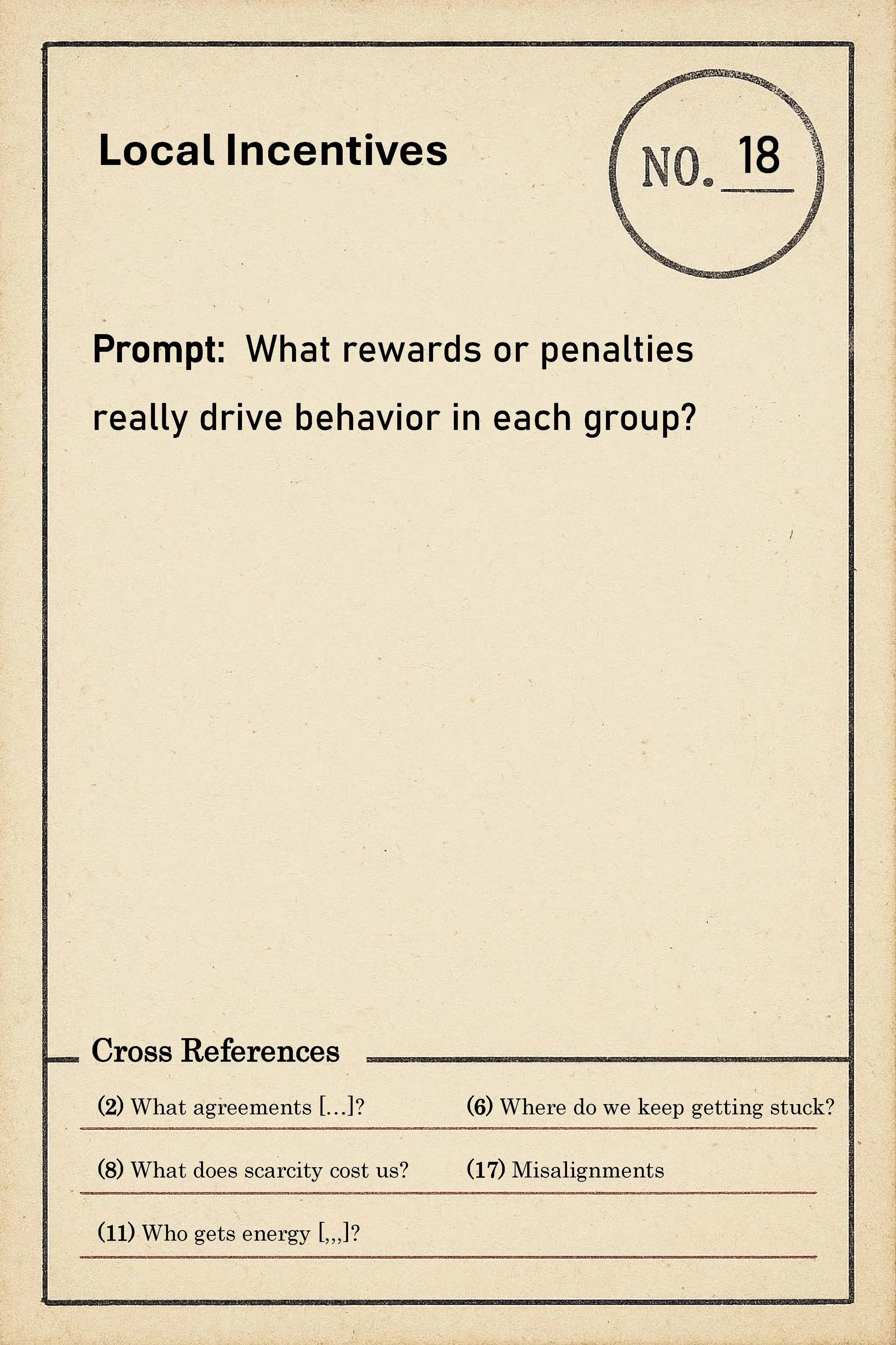
What Are We Rewarding?
Use this when people game the numbers, chase bonuses that hurt wider value, or hide behind “we’re just following incentives.” This card helps surface how incentive agreements shift behavior—and where the organisation pays the unseen price.
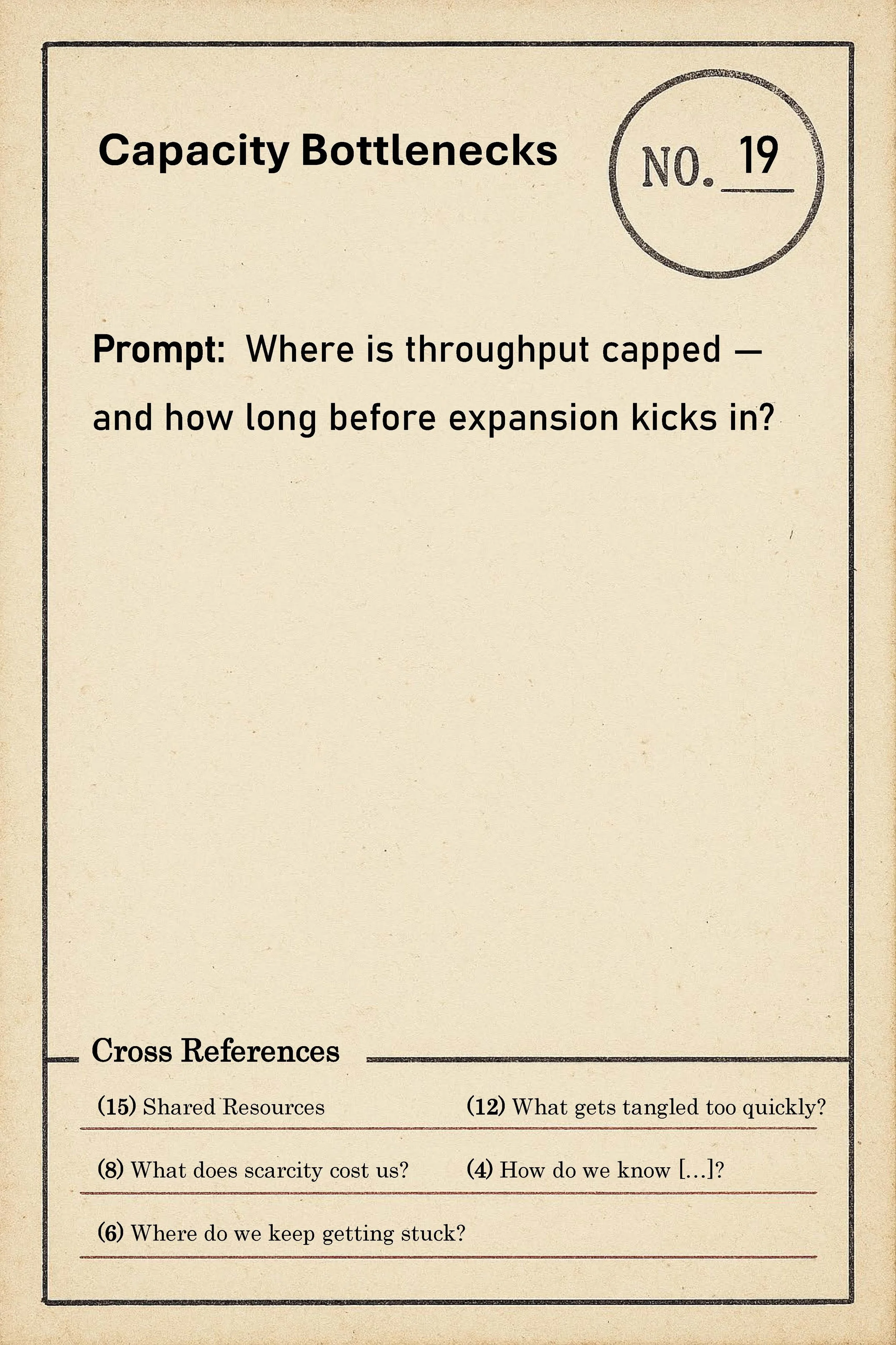
Where Is Capacity Breaking?
Use this when backlogs grow, delivery delays erode trust, or people/machines run at permanent max. This card helps surface capacity agreements—where load, buffers, and investment timing create both urgency and risk.
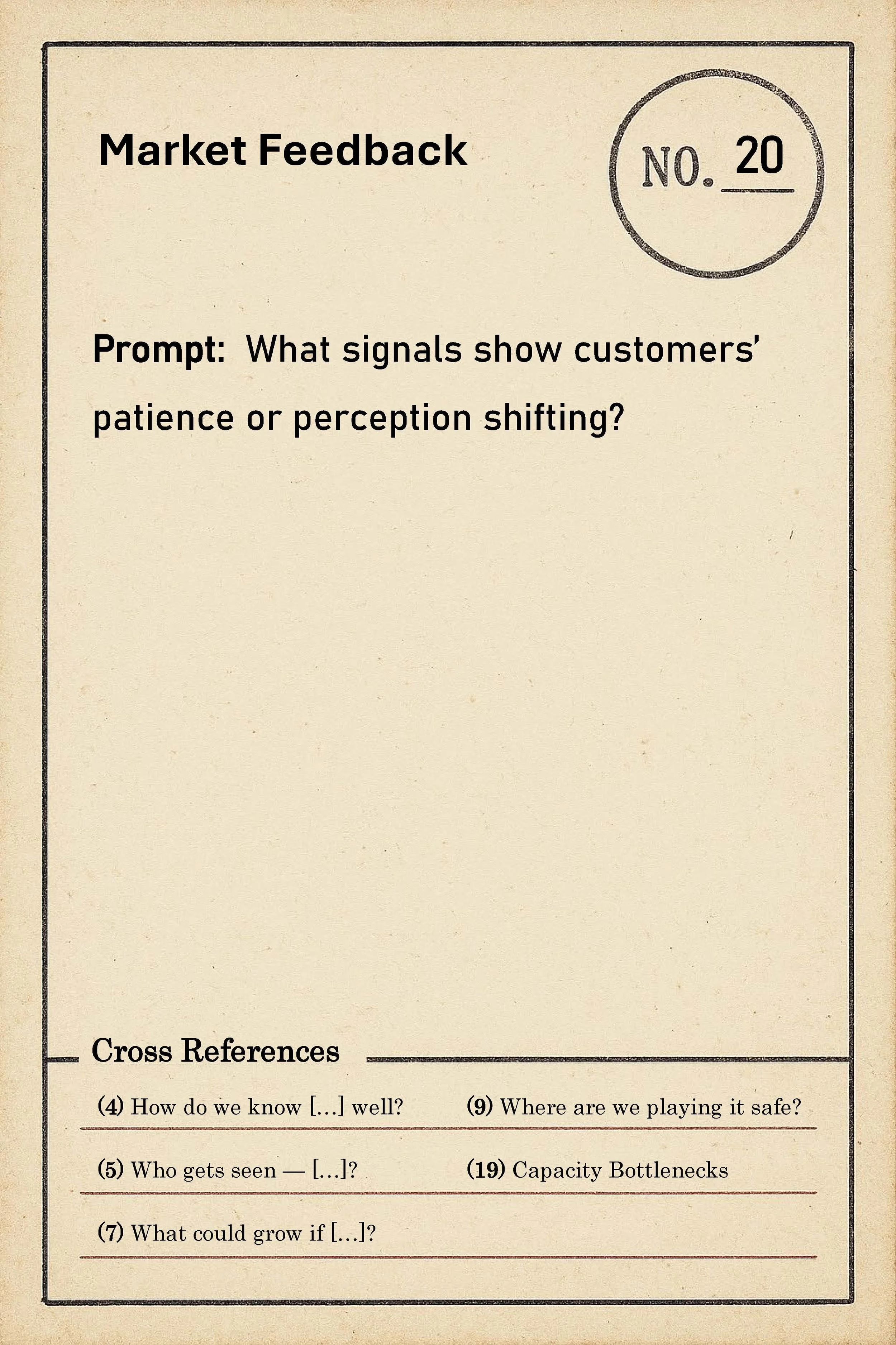
What Does the Outside Feel?
Use this when complaints spike, social chatter turns, sales outpace fulfilment, or marketing promises drift from reality. This card helps test whether internal metrics still match the lived customer/stakeholder experience.

Resources in Play
Use this lens to ground the conversation in reality. Before you talk solutions, get clear on what is actually available (and what is not): time, attention, skills, cash, data, relationships, capacity, reputation. Most “agreement problems” start as resource assumptions that nobody has made explicit.
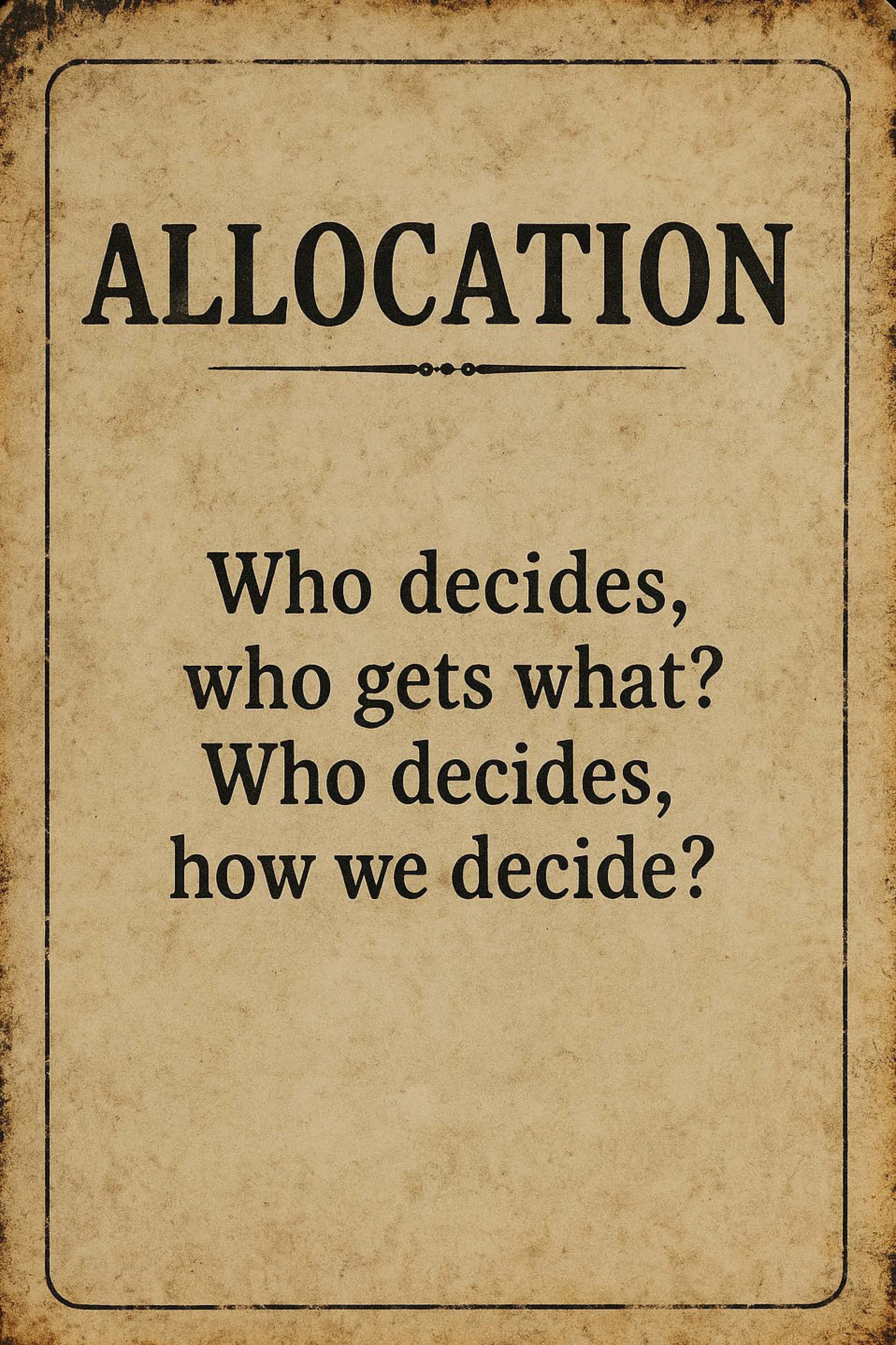
Decision Rights
Use this lens to surface who can commit resources—and who can’t. It clarifies who decides, who must be consulted, who can block, and who silently carries the consequences. When decision rights are unclear, systems drift into delays, side deals, and surprise decisions.
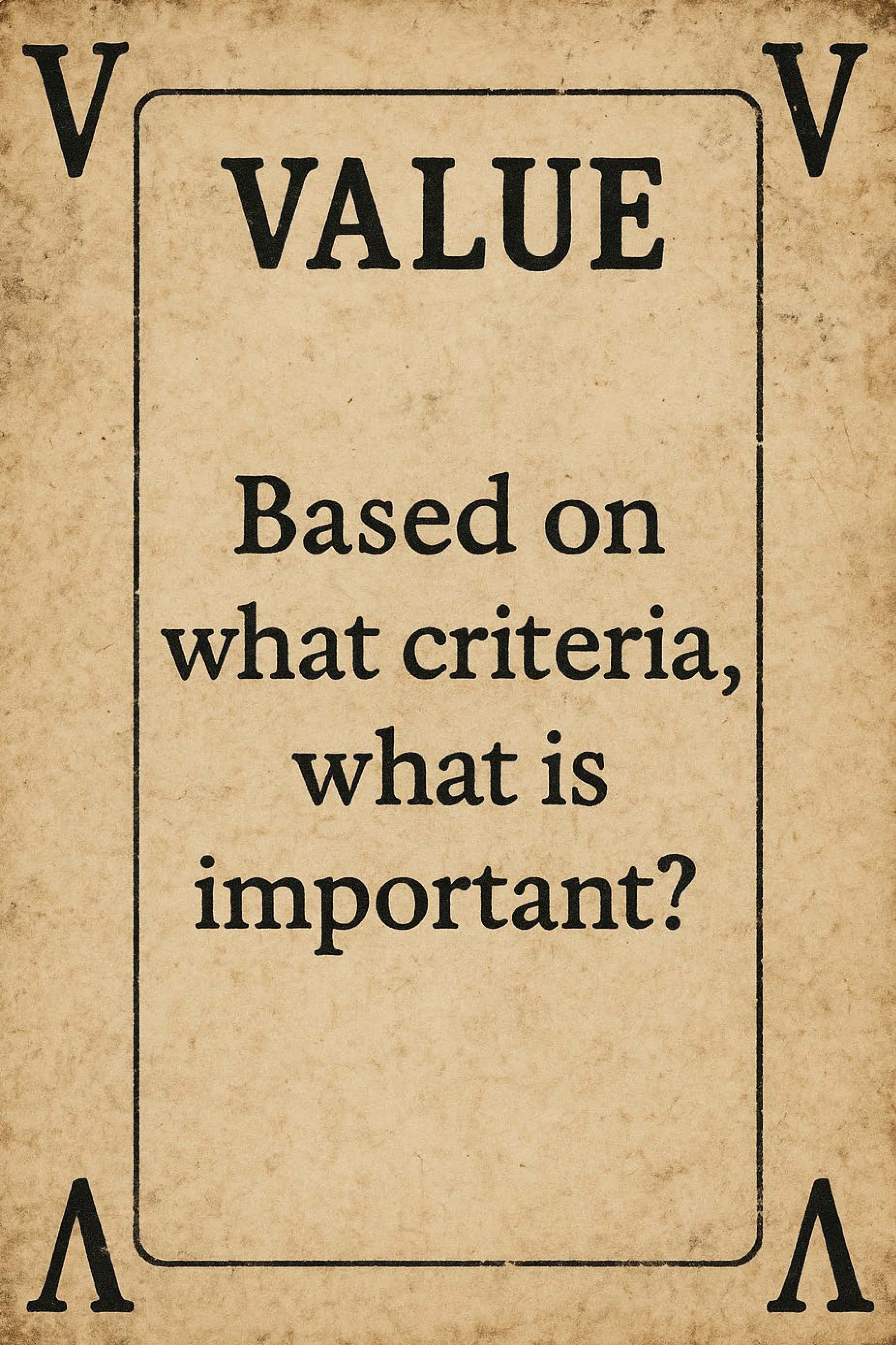
Value Rules
Use this lens to make criteria explicit. Every allocation decision uses a rule: profit, fairness, safety, customer impact, speed, loyalty, compliance, identity, and long-term resilience. This card helps reveal which rules are actually operating (not just what people say), and where competing rules create friction.
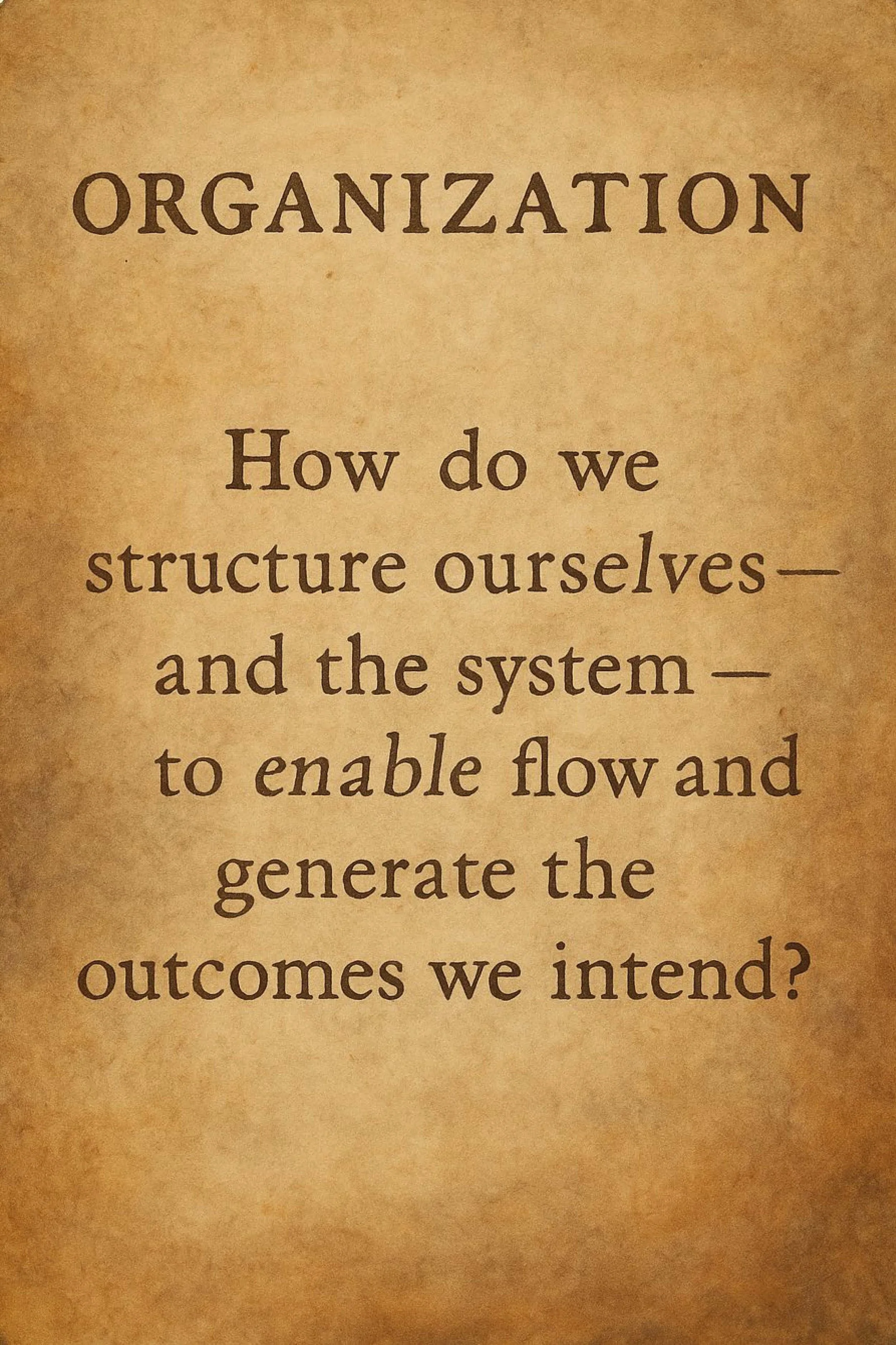
Coordination Architecture
Use this lens to see how the system makes decisions real. It surfaces the routines, handovers, meetings, artifacts, escalation paths, and feedback loops that turn intentions into action. If resources, rights, and rules are clear but coordination is heavy, the architecture—not the people—is the bottleneck.