
Why Your System Won't Move, No Matter Who Pushes
Context note: This post presents conceptual research reflections. It does not describe, assess, or report on any specific organization. All examples are synthetic or composite and non-attributable.
If you hold a mandate, a budget, or the power to open a door, you have probably watched this happen. A goal that everyone agrees on. Capable people working hard toward it. Resources committed. And year after year, the system does not move, or moves in the wrong direction, and no one can quite say why.
What is striking is how little the field seems to matter. The same conversation recurs whether the subject is food, the energy transition, financial risk, the protein transition, circular transition, military transformation, digital transformation, grid congestion, talent, or housing, and the list goes on. The sector changes, the people change, and the story stays the same.
The reflex is to look for the missing ingredient—more money. Better leadership. The right policy. Another round of convening. Sometimes that is what is missing. More often than not, none of it is, because the problem is not a missing part. The problem is that no one standing anywhere in the system can see the whole of it. Each person sees their own part with great clarity, and everyone else's as friction.
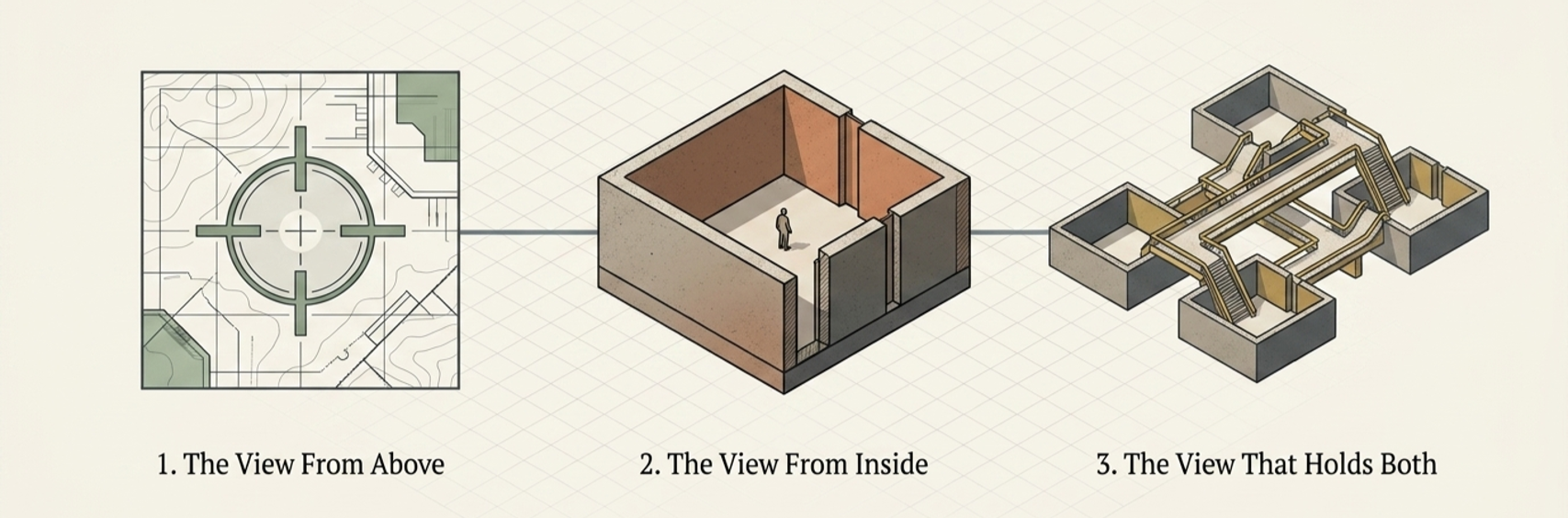
The Three Positions of Systemic Change: To understand why a system refuses to move, you must occupy three distinct optical positions. You cannot rely on just one, because each position is structurally blind to exactly what the next one reveals.
This is not a failure of intelligence or of will. It is a structural condition of large systems, and there are disciplined ways of working with it. The approach I have chosen, and in my view the strongest, has been developed and tested over decades across many fields and large systems, in the tradition of strategic systems analysis associated with Jim Ritchie-Dunham and the Institute for Strategic Clarity. It also sits within the wider field of large-systems change, where Steve Waddell, one of that field's central voices, cites it in his work on how large systems shift. I want to describe not the tools of that work but the single idea beneath it, because that idea is what a leader actually needs to grasp before committing more money or more time.
The idea is this. To understand why a system will not move, you have to look at it from three positions that no single participant ever occupies at once. And the reason you need three, rather than one good one, is that each position is blind to exactly what the next one reveals. That blindness is not a defect. It is the reason the approach is built the way it is.
Let me carry a composite case alongside, drawn as an illustration rather than a report: a region trying to rebuild something its people depend on, with producers, buyers, funders, public bodies, and civic groups all involved, all willing, and all stuck.
The view from above: The first position looks at the whole. It asks what the shared goal actually is, and then it does something most conversations skip: it asks. It traces how the thing the goal measures has really moved over many years, and where it is heading if nothing changes. A goal that was a slogan becomes a line with a history. From there, it asks which actors hold power over that line and which are pulling with it or against it, and it names the recurring dynamics that keep producing the same result.
This view is clarifying, and it is where most strategies stop. It shows the shape of the whole: the trajectory, the balance of power, the repeating patterns. What it cannot show is why any single actor behaves the way they do. From the above, the producer who will not cooperate and the funder who waits for proof appear to be obstacles. Why each is behaving sensibly, from where they stand, is invisible. And you cannot move people you have reduced to obstacles.
The view from inside: So the second position abandons the overview and enters each actor's world in turn. It asks what this particular actor is trying to do, what they are rewarded and punished for, and which parts of the system they genuinely control. Seen this way, the obstacle dissolves. The producer will not cooperate because, from inside their situation, the numbers do not add up. The funder waits because, from inside theirs, the risk cannot be priced. No one is being unreasonable. Each is responding accurately to the part of the system they live in. Put these accounts side by side, and you see the thing the view from above could never explain: how a system full of reasonable people, each doing the sensible thing, produces an outcome that not one of them wants.
This is the view that ends blame, and ending blame is often the first real movement a stuck system makes. But it has its own blindness. Understanding why each part behaves as it does tells you why the system holds its shape. It does not tell you where, across the whole, a push would actually move it. You can understand everyone perfectly and still have nowhere to place your hand.
The view that holds both: The third position does not go back up. It stands on the two views at once and asks a question neither could reach: given the shape of the whole and the reason inside each part, which few things actually carry this system, and who holds them? Here, the system stops being goals or viewpoints and becomes a small number of resources that everything else depends on.
Two things come into view that were invisible before. The first is that the resource that most decides whether the system can move is usually not money or infrastructure. It is something relational, often trust among the actors, and it has a strange property. Many people have the power to lower it, and no one has been made responsible for building it. Power over it is everywhere; responsibility for it is nowhere; so it drains quietly while everyone tends to their own part. The second is that the measures the system uses to judge itself are measuring the old game, the one it is trying to leave. The thing it depends on most is not counted anywhere, so the system cannot see what it is actually short of.
This third view can only see these things because it is standing on the other two. Take away the shape or the reasons, and you are left with a list of variables and no story to make sense of them.
Why three, and not a shortcut
Set out this way, this is not a technique for fixing a system, and I would be wary of anyone who sold it as one. It is a way of seeing, and its strength lies in its acceptance of its own limits. Each view is built to be blind to what the next one shows, which is exactly why you need all three, and why no shortcut through one of them holds. The three positions are not three opinions to average. There are three necessary passes, and the approach is built around that necessity rather than around any single clever view.
It leaves me with one honest question, and it is the one I think matters most for anyone about to commit money or authority. This way of seeing ends by making a system's agreements visible so they can be worked with. But the agreements that hold a stuck system in place are often the ones no one has ever spoken aloud, the quiet understandings that keep things coordinated precisely because they were never made explicit. If that is so, then even the clearest view of a system may not reach the very things that decide whether it moves.
That is where I want to look next. It is not a gap in the seeing. It is the edge where seeing runs out.
This is the first of two reflections. The second takes up the edge named here: why a system's most decisive agreements are so often the ones that resist being seen, and what that means for the idea that a way of working like this can be handed to someone else.
Sources and lineage:
Ritchie-Dunham, J. L., & Rabbino, H. T. (2001). Managing from clarity: Identifying, aligning, and leveraging strategic resources. Wiley.
Ritchie-Dunham, J. L., & Pruitt, B. (2014). Ecosynomics: The science of abundance. Vibrancy Publishing.
Meadows, D. H. (2008). Thinking in systems: A primer. Chelsea Green.
Senge, P. M. (1990). The fifth discipline: The art and practice of the learning organization. Doubleday/Currency.
Waddell, S. (2011). Global action networks: Creating our future together. Palgrave Macmillan.
Waddell, S. (2016). Change for the audacious: A doer's guide to large systems change for a flourishing future. NetworkingAction.
Waddell, S. (2016). Societal change systems: A framework and tool to address wicked problems. Journal of Applied Behavioral Science, 52(4), 422-449.