
When “Network” and “Ecosystem” Get Blended, I Stop Being Neutral
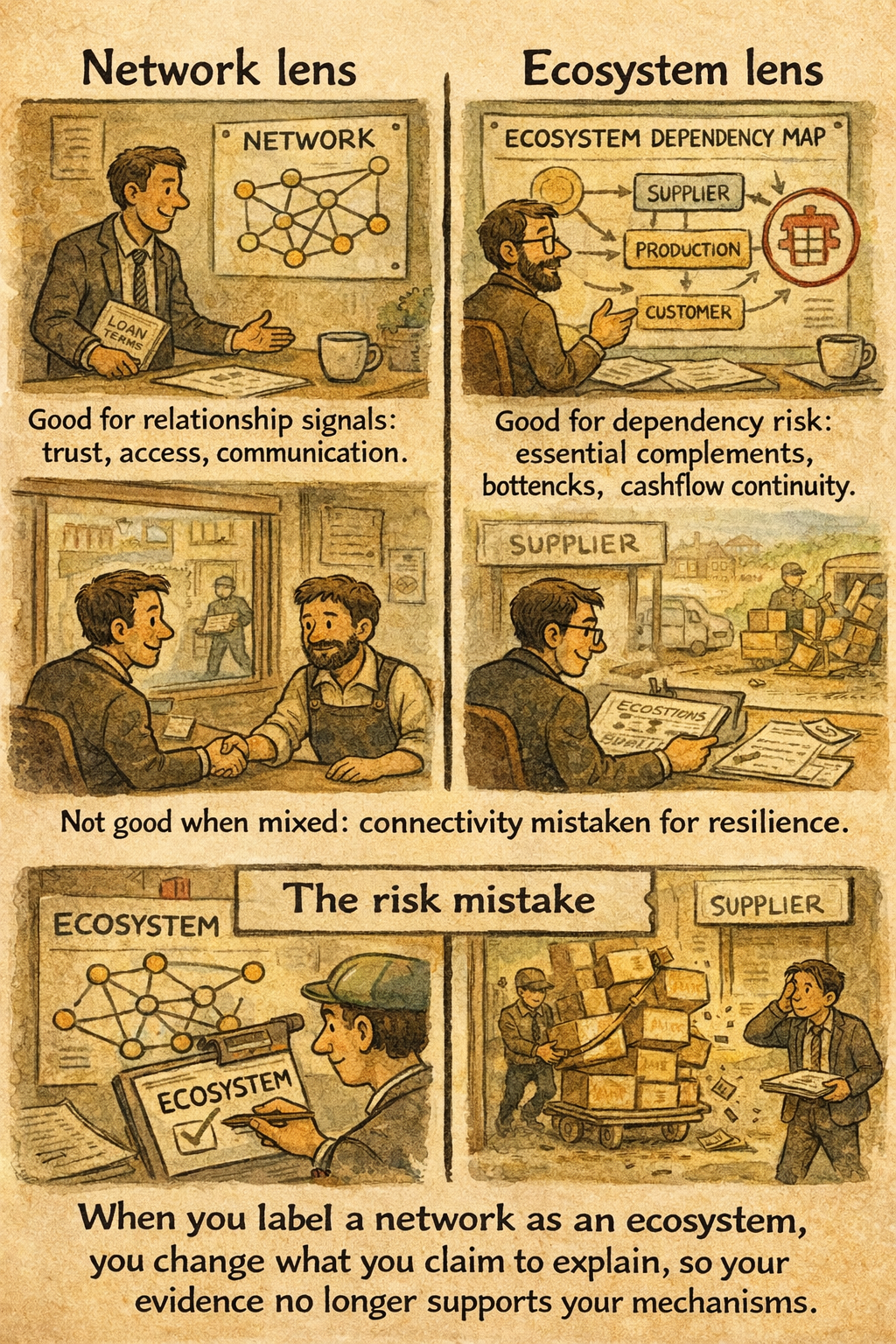
Relationship cues can help you judge trust and access (Uzzi 1999), but they can hide fragile dependencies. When you treat “well connected” as “structurally safe,” surprises arrive late and hit harder.
Lately, I noticed something across my practitioner and researcher communities. It caused something in me that I did not expect. I cannot stay neutral anymore when I am around “ecosystem” talk. The constant mixing of networks, systems, and ecosystems annoys me, not because I want to police language, but because the mix quietly changes what people think they are studying and working in. Once the construct shifts, the claims shift with it. Once the claims shift, the evidence becomes harder to interpret.
A line from William Burroughs has been echoing in my head while watching this happen: “Words are still the principal instruments of control. Suggestions are words. Persuasions are words. Orders are words.” (Burroughs, 1978). I am not using him to make a grand political point here. I am using him as a reminder that language is never just decoration. Words shape what becomes “real enough” to coordinate around. In research, they also shape what becomes “real enough” to measure.
This reaction also did not come out of nowhere. Years ago, I read a blog post by Jim Ritchie-Dunham that has stayed with me. It has accompanied me for a long time because it keeps giving me a clean knife for cutting through fuzzy “ecosystem” talk. His move is almost disarmingly modest: he looked up dictionary definitions, noticed how easily they blur the terms, and then tipped his hat back to Russell Ackoff, whose distinctions are sharper than most contemporary ecosystem papers (Ritchie-Dunham, 2021; Ackoff, 2010).
Ackoff’s thinking and distinction keep me anchored. A network is a set of interrelated parts whose primary power lies in robust communication among them. A system is a set of interrelated parts where each part’s contribution is essential to the purpose and behavior of the whole. In other words, a network can lose nodes and still function because the defining characteristic is connectivity. A system is defined by a function in a larger whole, and it depends on essential parts whose contributions are interdependent. Remove an essential part, and the system cannot do what it exists to do. (Ackoff, 2010).
Once you take this seriously, a lot of “ecosystem” talk becomes easier to diagnose. In strategy and management research, “ecosystem” is commonly used to describe interdependence across organizations and activities that must align for a value proposition to materialize. It is not only about who is connected, or who knows whom, or who talks to whom. It is about complementary roles, coordination interfaces, and alignment constraints that determine whether the whole can perform. That is why ecosystem work, at its best, is not a fancier word for networking. It is a different unit of analysis! (Adner, 2017; Jacobides, Cennamo, & Gawer, 2018).
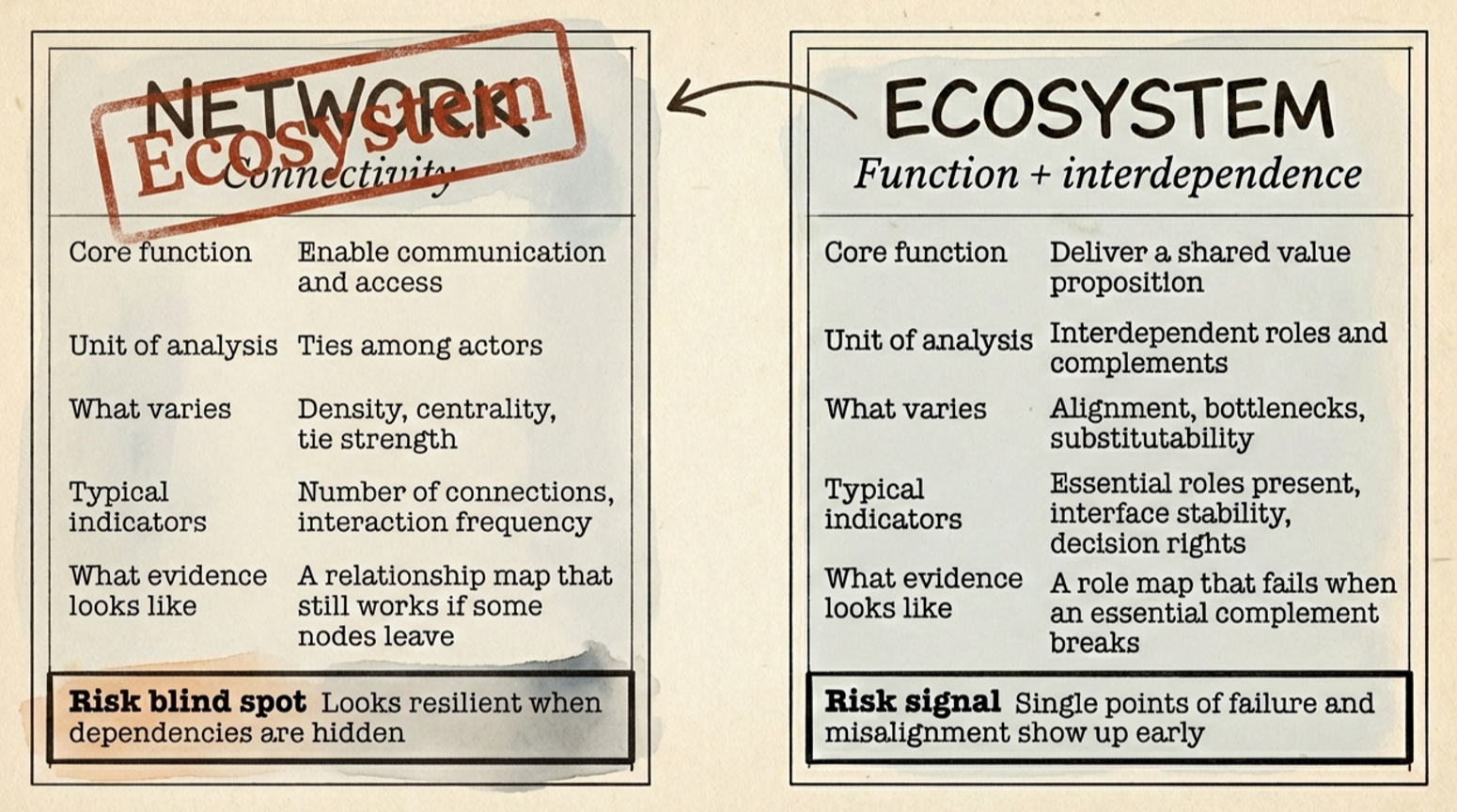
A quick field guide for keeping the concepts clean: what you are studying, what can change, and what kind of evidence actually fits the claim.
Now here is the part that makes this more than a pet peeve. Roy Suddaby’s argument about construct clarity explains why the slippage is so damaging. His point is that theory does not collapse mainly because people lack sophistication. It collapses because the key terms are not stable enough to carry cumulative knowledge. If a construct is fuzzy, two researchers can use the same word while studying different phenomena, and nobody notices until results refuse to line up (Suddaby, 2010).
Suddaby also offers a practical discipline that maps almost perfectly onto the network-versus-ecosystem mess. Give the central term an identity card. Do not only define it, but also define what it is not, by naming the closest neighbor constructs and drawing the boundary on purpose. State the scope conditions, meaning when the construct applies, at what level, and for which unit of analysis. Keep the construct separate from its indicators, meaning do not confuse the thing you claim exists with the proxy you happen to measure. Make the dimensions explicit if the construct has multiple aspects. And then stabilise meaning with disciplined examples and non-examples, so the reader can see what would count as evidence and what would not. (Suddaby, 2010).
Hence, I argue, the network-versus-ecosystem confusion is not a cosmetic problem. It produces predictable failure modes that are methodologically avoidable, yet culturally normalised. When you label a network as an ecosystem, you change what you claim to explain, so your evidence no longer supports your mechanisms.
One failure mode shows up in literature reviews. If a search strategy treats “end “network” as interchangeable proxies for the same context category, the corpus can silently mix different logics. You can sometimes clean this up later through screening and coding, but only if you state clear eligibility rules that are strong enough to maintain the construct. Otherwise, the review becomes replicable in process while conceptually unstable in content, and the synthesis starts blending connectivity logic with functioning logic. (Suddaby, 2010).
Another failure mode shows up in “mechanism” language. Mechanisms only mean something relative to a unit of analysis. In network logic, mechanisms are often about tie formation, brokerage, diffusion, trust propagation, and access to resources through connections. In ecosystem logic, mechanisms are about alignment across complementary roles, governance of interdependence, value-creation bottlenecks, and coordination interfaces that make the whole work or not. Both sets are real. The problem is treating them as the same thing because they sound similar in everyday English. (Adner, 2017; Jacobides et al., 2018; Suddaby, 2010).
A third failure mode is rhetorical, and it is where my patience tends to disappear. It appears in verbs like “orchestrate” and “steer.” In network settings, it is reasonable to talk about shaping connectivity, convening, brokering, and influencing flows. In ecosystem settings, those verbs often smuggle in a control assumption. An ecosystem can exhibit performance patterns without any actor having the position to manage the whole. Agency exists, but it needs to be specified as role-bound contributions to alignment, not as whole-system control. (Adner, 2017; Jacobides et al., 2018).
A fourth failure mode becomes visible when this slippage reaches banking, especially SME credit assessment. In practice, lenders often rely on relationship signals and accumulated “soft information” to assess small firms under uncertainty, because hard data is limited and context matters (Petersen & Rajan, 1994; Berger & Udell, 2002). Those signals are real and useful, but they are network evidence: they tell you about ties, trust, access, and communication. If that evidence is then interpreted as ecosystem evidence, the assessment can drift into a dangerous shortcut: connectivity starts to stand in for resilience or even worse for anti-fragility.
In an ecosystem understood as a system, resilience is not primarily a function of the number of ties. It is a function of whether essential complements hold and whether the firm can continue to perform its role when those complements fail, withdraw, or are disrupted (Ackoff, 2010; Adner, 2017). That difference matters for credit risk because SMEs often carry concentrated dependencies that do not show up in a “well-connected” story: a dominant customer, a single critical supplier, a single logistics channel, a toxic leadership relation, or a single gatekeeper. Research on customer-base concentration shows that such dependency structures can materially shape firm outcomes (Patatoukas, 2012). Research on supply chain disruptions shows how operational shocks can be associated with meaningful performance effects (Hendricks & Singhal, 2005). Neither of those risks is captured by counting connections or admiring relationship quality. As far as my literature research goes, neither of those risks are integrated into ecosystem research.
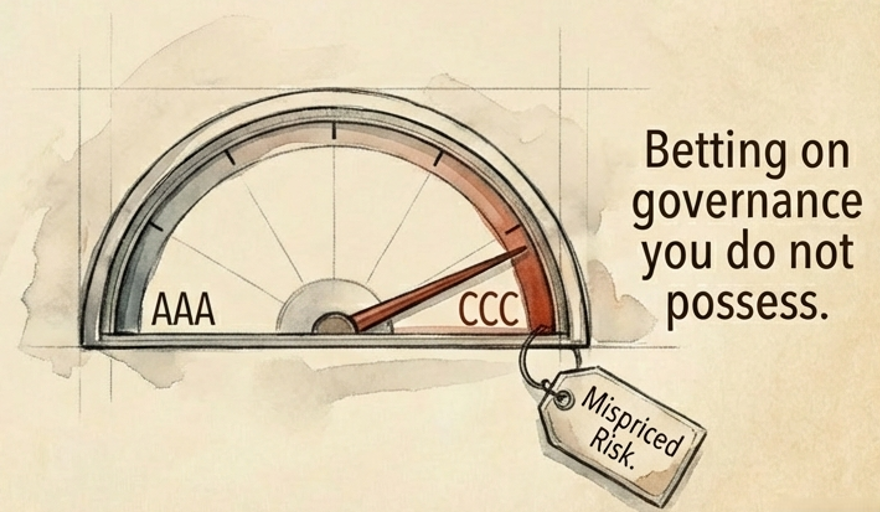
When we mislabel what we are embedded in, we choose the wrong lens. We then measure the wrong signals, assume coordination equals control, and overestimate our ability to steer outcomes. That is a hidden bet on governance capacity we do not actually have. The result is mispriced risk: the situation looks safe on the dashboard, but behaves frantically when conditions change.
When I want a quick reality check, I borrow the spirit of Ackoff’s distinction and turn it into a practical heuristic. I ask whether the phenomenon I am observing is defined primarily by connectivity or by function. If a key actor leaves and the remaining structure can route around the absence, keeping communication flowing, I am probably looking at network properties. If a key role disappears and the whole loses its ability to perform a function because an essential complement is missing, I am in system territory, and often in ecosystem territory once inter-organizational complementarity is part of the story. This is not a perfect test, and it is not meant to be. It is a clarity move, and clarity is exactly what Suddaby is demanding. (Ackoff, 2010; Suddaby, 2010).
At this point, it is worth saying what I am not saying. I am not claiming that network studies are inferior. I am not claiming that ecosystem research is useless. In many empirical settings, network dynamics and ecosystem dynamics coexist. The problem is when we slide between them without noticing, because the slide makes our claims easier to sell and harder to falsify. That is when “ecosystem” becomes a vague umbrella term, and the field ends up producing elegant language that cannot carry the weight of explanation.
This is where my neutrality breaks down, because clarity of construction is not academic etiquette. It is part of the measurement instrument. If we cannot keep our constructs clean, we cannot keep our evidence clean. And if our evidence is unclear, our “mechanisms” risk becoming well-formulated metaphors. Burroughs’ line lands differently for me in that light: words are not only how we describe control, but they are also often how we exercise it, including in the soft form of steering attention, framing legitimacy, and protecting vague claims from hard testing. (Burroughs, 1978; Suddaby, 2010).
So yes, this is a provocative blog post, but it is not a rant. It is a methodological warning delivered in plain language: words do work. If we want the ecosystem field to mature, we should stop treating “ecosystem” as a prestige label for any collaborative setting and start stating, plainly, what we are analysing, what the function is, which roles are essential, what counts as evidence, and where the boundaries of agency really sit. That is not pedantry. That is how a community starts producing sharper, more useful knowledge. (Suddaby, 2010; Adner, 2017).
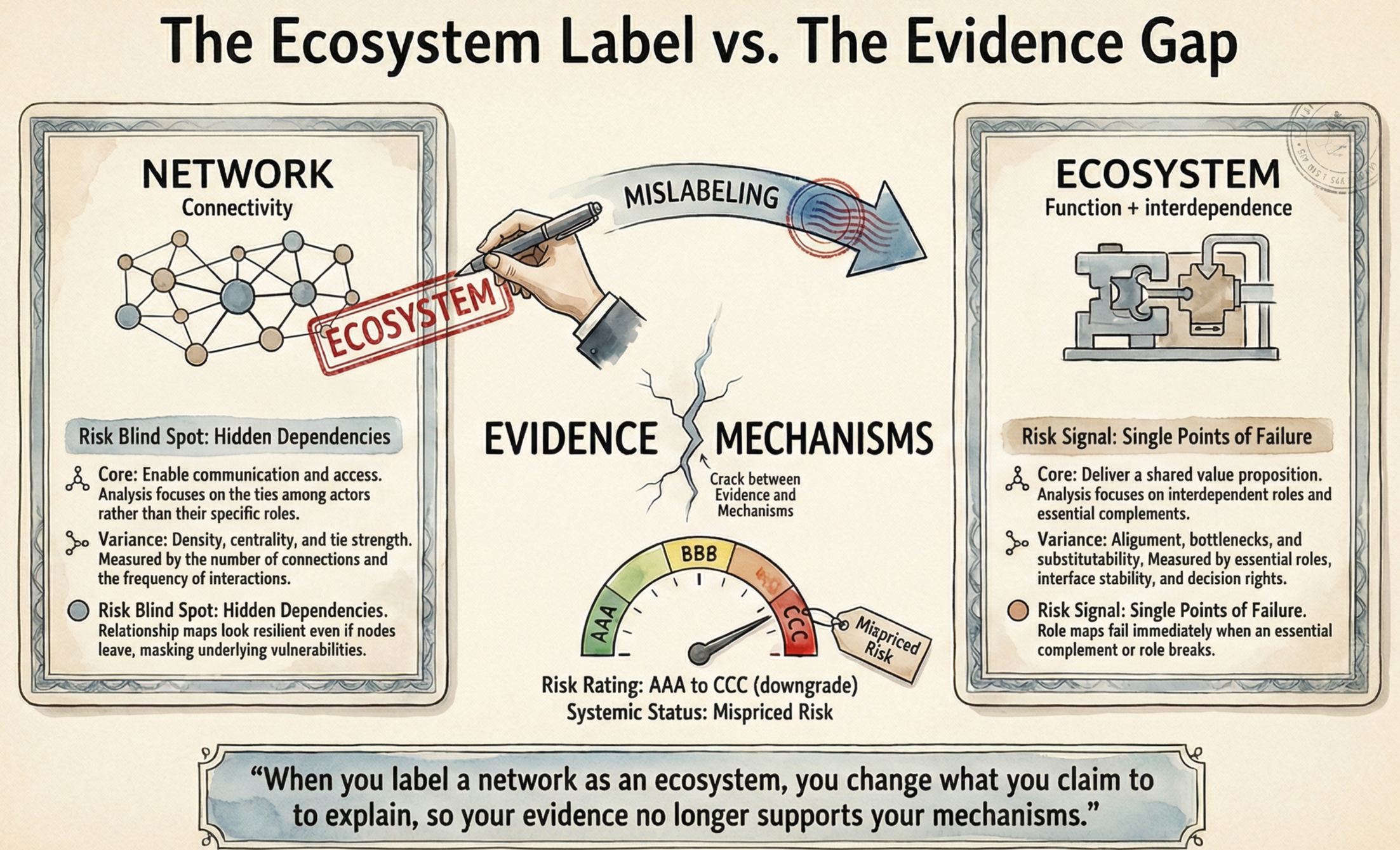
A label slip can break the logic chain: you collect one kind of signal, then explain it with a different kind of mechanism, and your conclusions stop being testable.
References
Ackoff, R. L. (2010). Differences that make a difference: An annotated glossary of distinctions important in management. Triarchy Press.
Adner, R. (tructure: An actionable construct for strategy. Journal of Management, 43(1), 39–58. https://doi.org/10.1177/0149206316678451
Berger, A. N., & Udell, G. F. (2002). Small business credit availability and relationship lending: The importance of bank organisational structure. The Economic Journal, 112(477), F32–F53. https://doi.org/10.1111/1468-0297.00682
Brand, U. (2016). “Transformation” as a new critical orthodoxy: The strategic use of the term “transformation” does not prevent multiple crises. GAIA: Ecological Perspectives for Science and Society, 25(1), 23–27. https://doi.org/10.14512/gaia.25.1.7
Burroughs, W. S. (1978). The limits of control. Semiotext(e): Schizo-Culture, 3(2), 38–42.
Heikkurinen, P. (2019). Degrowth: A metamorphosis in being. Environment and Planning E: Nature and Space, 2(3), 528–547. https://doi.org/10.1177/2514848618822511
Hendricks, K. B., & Singhal, V. R. (2005). Association between supply chain glitches and operating performance. Management Science, 51(5), 695–711. https://doi.org/10.1287/mnsc.1040.0353
Jacobides, M. G., Cennamo, C., & Gawer, A. (2018). Towards a theory of ecosystems. Strategic Management Journal, 39(8), 2255–2276. https://doi.org/10.1002/smj.2904
Patatoukas, P. N. (2012). Customer-base concentration: Implications for firm performance and capital markets. The Accounting Review, 87(2), 363–392. https://doi.org/10.2308/accr-10198
Petersen, M. A., & Rajan, R. G. (1994). The benefits of lending relationships: Evidence from small business data. The Journal of Finance, 49(1), 3–37. https://doi.org/10.1111/j.1540-6261.1994.tb04418.x
RitchMay 10). Are we a system or a network? A hat tip to Russell Ackoff, again [Blog post].
Suddaby, R. (2010). Editor’s comments: Construct clarity in theories of manaon. Academy of Management Review, 35(3), 346–357. https://doi.org/10.5465/amr.35.3.zok346
Uzzi, B. (1999). Embeddedness in the making of financial capital: How social relations and networks benefit firms seeking financing. American Sociological Review, 64(4), 481–505. https://doi.org/10.1177/000312249906400402